
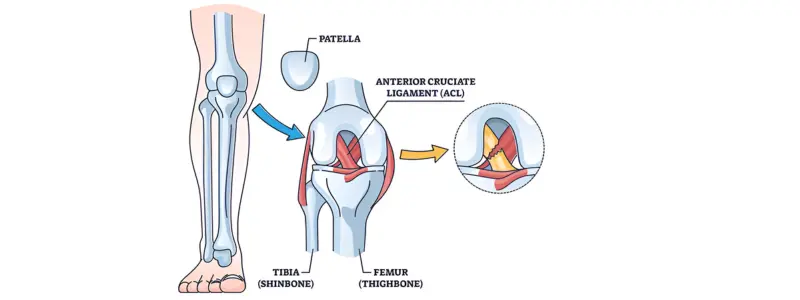
The posterior cruciate ligament (PCL) is one of the main ligaments inside the knee. It stops the shin bone from moving backward under the thigh bone. A PCL tear usually follows a direct blow to the front of a bent knee, such as a dashboard injury in a road accident or a fall onto the knee.
Many PCL tears, especially partial tears, are treated without surgery, with a brace and physiotherapy. PCL reconstruction is advised mainly when other ligaments are also torn, or when the knee stays unstable or painful despite proper rehabilitation.
At PMG Hospital, Gota, PCL reconstruction is performed arthroscopically (keyhole surgery). This page explains how the PCL tears, the signs and grades of injury, when surgery is needed, graft options, the procedure, recovery, risks and cost factors.
What Is the PCL, and How Does It Tear?
The PCL lies behind the anterior cruciate ligament (ACL), in the centre of the knee. It is thicker and stronger than the ACL. It usually tears when a strong force pushes the shin bone backward, for example when a bent knee strikes the dashboard of a car, in a fall onto the front of a bent knee, or in a heavy tackle in sport.
A PCL tear may occur on its own or together with injuries to other ligaments, the meniscus or the cartilage. A PCL tear that occurs with several other ligament injuries may be part of a knee dislocation, which needs emergency assessment.
Related pages: ACL reconstruction·Knee dislocation·Arthroscopy
Signs of a PCL Injury
- Pain and swelling of the knee after the injury, which may be milder than after an ACL tear
- Pain at the back of the knee
- Difficulty kneeling or squatting
- A feeling that the knee is unstable, especially on stairs or slopes
- Pain at the front of the knee that develops months later
Numbness, coldness or a weak pulse in the foot after a knee injury, or a knee that looks out of shape, can mean a knee dislocation with injury to the blood vessels. Call 108 or go to the nearest emergency facility immediately.
Assessment and Grades of PCL Tears
A PCL reconstruction doctor in Ahmedabad - an orthopaedic surgeon - examines the knee and checks how far the shin bone moves backward. MRI confirms the tear and shows whether other ligaments, the meniscus or the cartilage are injured. Stress X-rays are sometimes used to measure the backward movement. A complete tear is checked carefully for injury to the outer back corner of the knee (the posterolateral corner), because this changes the treatment.
| Grade | What it means | Usual treatment |
|---|---|---|
| Grade I | Partial tear with mild looseness | Brace and physiotherapy |
| Grade II | Partial tear with more looseness | Brace and physiotherapy |
| Grade III | Complete tear | Often a brace and physiotherapy first when the PCL tear occurs on its own; reconstruction is usually advised when other ligaments are also torn, or when the knee stays unstable or painful |
Treatment Without Surgery
Non-surgical treatment usually includes a special PCL brace that supports the back of the shin bone, and physiotherapy to strengthen the thigh muscles, especially the quadriceps, and to improve movement and balance. A PCL reconstruction treatment hospital in Ahmedabad should provide this rehabilitation as well as surgery, because many PCL tears do not need an operation.
ACL vs PCL - How They Differ
| ACL | PCL | |
|---|---|---|
| Position | In the centre of the knee, in front of the PCL | In the centre of the knee, behind the ACL |
| Main role | Stops the shin bone from moving forward and twisting | Stops the shin bone from moving backward |
| Usual cause of injury | A twist, pivot or awkward landing in sport | A direct blow to the front of a bent knee, such as a dashboard injury or a fall onto the knee |
| How common | More common | Less common |
| Healing without surgery | A complete tear rarely heals | Many partial tears heal with a brace and physiotherapy |
What Is PCL Reconstruction?
In PCL reconstruction, the torn ligament is replaced with a tendon graft. The graft is passed through tunnels in the thigh bone and shin bone, at the positions of the original ligament, and fixed in place. Over the following months, it heals into the bone and becomes a new ligament. When other ligaments are also torn, they are repaired or reconstructed in the same operation or in stages.
Graft Options
The graft is usually the patient's own hamstring or quadriceps tendon. A donor tendon (allograft) is sometimes used, especially when several ligaments need reconstruction. The surgeon explains which graft suits the injury.
PCL Reconstruction Surgery in Ahmedabad: Step by Step
The main steps are similar in any PCL reconstruction surgery hospital in Ahmedabad:
- 1Anaesthesia: spinal or general anaesthesia, often with a nerve block for pain relief
- 2Arthroscopy: the knee is inspected with a camera, and the meniscus and cartilage are checked and treated if needed
- 3Graft harvest: the chosen tendon is taken through a small cut and prepared
- 4Tunnels: tunnels are drilled in the thigh bone and shin bone, with X-ray guidance during surgery; special care is taken to protect the blood vessels and nerves behind the knee
- 5Graft fixation: the graft is passed through the tunnels and fixed with screws, buttons or other fixation devices
- 6Closure: the cuts are closed, and the knee is placed in a brace
Recovery After PCL Reconstruction
| Time | What usually happens |
|---|---|
| First weeks | Brace that supports the back of the shin bone; crutches with limited weight on the leg, usually for about six weeks; physiotherapy for swelling, movement and the quadriceps muscles |
| Weeks 6–12 | Walking without crutches when allowed; gradual increase in movement and strengthening |
| Months 3–6 | Brace usually continued for three to six months; progressive strengthening and balance work |
| Months 6–9 | Running and sport-specific training, when allowed |
| About 9–12 months | Return to sport, after strength and control tests |
Rehabilitation after PCL reconstruction is more protective than after ACL reconstruction, because the graft must be shielded from forces that push the shin bone backward. Desk work may be possible within a few weeks, depending on the job and travel.
Risks and Possible Complications
PCL reconstruction is a more complex operation than many other arthroscopic procedures. The surgeon explains these risks before taking consent.
- Infection of the wound or inside the joint, which is uncommon but may need further surgery
- Bleeding into the joint (haemarthrosis) or swelling that takes time to settle
- Blood clots in the leg veins (deep vein thrombosis) or lungs (pulmonary embolism)
- Stiffness or loss of movement
- Numbness of the skin around the incisions
- Continuing pain in some patients
- Anaesthesia-related and general medical risks
- Injury to the main blood vessel or nerves behind the knee during surgery, which is rare but serious
- Some remaining looseness of the knee, or stretching or failure of the graft
- Arthritis later in life, especially of the kneecap joint and the inner side of the knee
PCL Reconstruction Surgery Hospital in Ahmedabad
When choosing a PCL reconstruction hospital in Ahmedabad, check that the treating surgeon is a qualified orthopaedic surgeon with valid medical council registration, that the hospital regularly performs this operation, how infection is prevented, which implants and tests are available, what physiotherapy and follow-up are provided, and what the written estimate includes.
Look beyond general phrases such as "a PCL reconstruction hospital with modern facilities" and ask which facilities are actually available on site.
PCL Reconstruction Surgery Cost in Ahmedabad
- The graft and the fixation implants used
- Whether other ligaments also need surgery
- The type of anaesthesia
- Length of hospital stay and room category
- The brace, physiotherapy and follow-up
A written, itemised estimate can be requested from the hospital after assessment.
Insurance
- Medically necessary PCL reconstruction is generally covered under health insurance policies, subject to policy terms, waiting periods and insurer approval
- Some policies have limits on room rent or implant costs; check these with your insurer before surgery
- Ask the hospital whether cashless treatment is available with your insurer, and which documents are needed
PCL Reconstruction Doctor in Ahmedabad
A PCL tear is assessed and treated by an orthopaedic surgeon, usually one who works in arthroscopy and knee ligament surgery. An emergency doctor often sees the patient first after a road accident or fall, and the orthopaedic surgeon decides between a brace with physiotherapy and reconstruction. Different doctors and team members are involved at different stages:
| Doctor or team member | Role in PCL injury care |
|---|---|
| Emergency doctor | First assessment after an accident or fall; checks the pulse and feeling in the foot and refers to an orthopaedic surgeon |
| Orthopaedic (arthroscopy and ligament) surgeon | Examines the knee, grades the tear, decides on non-surgical treatment or reconstruction, and performs the operation |
| Radiologist | Performs and reports the MRI and stress X-rays |
| Vascular surgeon | Consulted when a knee dislocation may have injured the blood vessels behind the knee |
| Anaesthetist | Assesses fitness for anaesthesia and plans spinal or general anaesthesia and nerve blocks |
| Physiotherapist | Guides brace use and the protective, staged rehabilitation programme |
PCL Reconstruction Surgery Doctor in Ahmedabad
Before agreeing to the operation, it is reasonable to ask your PCL reconstruction surgery doctor in Ahmedabad a few clear questions. The answers help you understand the plan and give informed consent.
- What grade is my PCL tear, and which test confirmed it?
- Are other ligaments, the outer back corner of the knee, the meniscus or the cartilage also injured?
- Can a brace and physiotherapy be tried first, and when would surgery be reconsidered?
- If other ligaments are torn, will they be treated in the same operation or in stages?
- How are the blood vessels and nerves behind the knee protected during surgery?
- Which movements and exercises must I avoid in the early months to protect the graft?
- What are the main risks in my case, including some remaining looseness of the knee?
- Which strength and control tests are done before a return to sport?
Treating Surgeon
At PMG Hospital, PCL reconstruction is performed by:
| Detail | Information |
|---|---|
| Name | Dr. Hiren Patel |
| Qualification | MS (Ortho), B.J. Medical College, Ahmedabad |
| Specialty | Orthopaedics |
| Designation | Director & Head Joint Replacement Surgeon, PMG Hospital |
| Registration status | Registered Medical Practitioner |
| Registration number | Gujarat Medical Council Reg. No. G-20583 |
| OPD availability | Monday to Saturday, 10:00 AM - 8:00 PM |
Facilities at PMG Hospital
- Orthopaedic OPD, Monday to Saturday
- Emergency and trauma care, 24×7
- Orthopaedic physiotherapy centre
Frequently Asked Questions
When should I see a doctor about a knee injury?
See an orthopaedic surgeon if, after a fall onto the knee, a road accident or a sports injury, there is pain and swelling, difficulty kneeling, or a feeling that the knee is unstable, especially on stairs or slopes. An examination and MRI show whether the PCL is torn and whether other ligaments, the meniscus or cartilage are also injured.
Do all PCL tears need surgery?
No. Most partial (grade I and II) PCL tears are treated without surgery, with a brace and physiotherapy. Many complete (grade III) tears that occur on their own are also treated with a brace and physiotherapy first. Reconstruction is usually advised when other ligaments are also torn, or when the knee stays unstable or painful despite proper rehabilitation.
What is the difference between an ACL and a PCL tear?
The ACL stops the shin bone from moving forward and usually tears during a twist or pivot in sport. The PCL lies behind the ACL, stops the shin bone from moving backward, and usually tears from a direct blow to the front of a bent knee, such as a dashboard injury or a fall onto the knee. PCL tears are less common, and many partial PCL tears heal with a brace and physiotherapy.
Can a PCL tear heal on its own?
Unlike a torn ACL, which rarely heals on its own, many partial PCL tears heal well with a PCL brace and physiotherapy. Some complete tears also heal, although some looseness may remain. A tear that leaves the knee unstable or painful, or that occurs together with other ligament injuries, may need reconstruction.
Which graft is used for PCL reconstruction?
PCL reconstruction usually uses the patient's own hamstring or quadriceps tendon. A donor tendon (allograft) is sometimes used, especially when several ligaments need reconstruction. The surgeon explains which graft suits the injury.
How long does recovery take after PCL reconstruction?
The knee is protected in a brace, often for three to six months, and crutches are usually needed for about six weeks. Physiotherapy starts early but follows a protective sequence. Desk work may be possible within a few weeks, and a return to sport usually takes about nine months to a year.
What facilities should a hospital have for PCL reconstruction?
It should have an operation theatre suitable for arthroscopic ligament surgery with strict infection-control practices, arthroscopy equipment and X-ray imaging during surgery, the fixation implants needed, anaesthesia services, access to MRI, and a physiotherapy service for protected rehabilitation.
What decides the cost of PCL reconstruction?
The cost depends on the graft, the fixation implants, whether other ligaments also need surgery, the type of anaesthesia, the length of hospital stay, room category, the brace and physiotherapy. A written, itemised estimate can be requested from the hospital after assessment.
Contact and Location
PMG Hospital
3rd Floor, Athena Avenue, B/H Jaguar Showroom, Nr. Eulogia Inn Hotel, Gota, Ahmedabad, India
- Phone / WhatsApp:
- +91 96627 70141
- OPD:
- Mon – Sat · 10:00 AM – 8:00 PM
- Emergency and trauma care:
- 24×7