
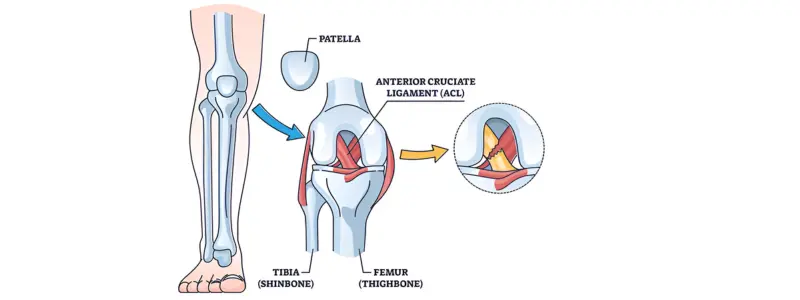
A true knee dislocation is a serious injury in which the thigh bone and the shin bone are pushed out of their normal position and two or more of the main knee ligaments are torn. It usually follows a high-energy injury, such as a road accident, a fall from a height or a sports injury, but it can occasionally happen with a smaller force, for example in people with a high body weight.
Because the main artery and nerves behind the knee can be injured at the same time, a knee dislocation is a medical emergency. After the emergency treatment, the torn ligaments usually need repair or reconstruction, followed by a long period of rehabilitation.
At PMG Hospital, Gota, emergency and trauma care is available 24×7, and multi-ligament knee reconstruction is performed after a knee dislocation. This page explains the emergency signs, first treatment, the difference from a kneecap dislocation, ligament surgery, recovery, risks and cost factors.
Why a Knee Dislocation Is a Medical Emergency
The popliteal artery, the main blood vessel to the lower leg, and the nerves next to it run behind the knee. When the knee dislocates, they can be stretched, compressed or torn. If the blood supply is blocked, it must be restored within a few hours (ideally within about six to eight hours), or the leg may be lost.
Many dislocated knees go back into place on their own before the person reaches hospital. Even then, the blood vessels and nerves can be injured, so the same emergency checks are needed.
Emergency Signs
| Sign | What it may mean | What to do |
|---|---|---|
| Numbness, coldness, pale skin or a weak pulse in the foot | The blood supply may be affected | Emergency: call 108 or go to the nearest emergency facility immediately |
| A knee that looks out of shape after an injury | The knee may be dislocated | Emergency assessment |
| Weakness of the foot or inability to lift the foot | Nerve injury | Emergency assessment |
| Severe pain, rapid swelling, inability to stand | A serious knee injury | Urgent assessment |
| Increasing, severe pain in the leg after the injury, especially pain on moving the toes | Rising pressure in the leg muscles (compartment syndrome) | Emergency assessment |
Emergency Treatment and Diagnosis
- 1Putting the knee back in place (reduction): done as soon as possible, under sedation or anaesthesia when needed
- 2Checking the circulation: the pulses in the foot are checked before and after the knee is put back in place, and the blood pressure at the ankle is compared with the arm (ankle–brachial index); if this is low or the pulses are abnormal, a CT angiogram is done
- 3Treating a blood vessel injury: a blocked or torn artery needs urgent surgery by a vascular surgeon
- 4Monitoring: the circulation and nerves are checked repeatedly over the first 24–48 hours, because an artery can become blocked hours after the injury, and the leg is watched for compartment syndrome
- 5Holding the knee: a brace or splint, or sometimes an external fixator (a frame outside the leg), keeps the knee in place
- 6X-rays and MRI: X-rays check for fractures; MRI shows which ligaments are torn and whether the meniscus and cartilage are injured, so that ligament surgery can be planned
A knee dislocation treatment hospital in Ahmedabad needs 24×7 emergency care, X-ray, rapid assessment of the circulation with access to CT angiography and vascular surgery, and close monitoring, as well as facilities for later ligament reconstruction. When emergency signs are present, go to the nearest emergency facility first rather than travelling to a more distant hospital.
Knee Dislocation vs Kneecap (Patellar) Dislocation
| True knee dislocation | Kneecap (patellar) dislocation | |
|---|---|---|
| What moves | The thigh bone and shin bone are pushed out of position | The kneecap slips out of its groove, usually to the outer side |
| How serious | An emergency; blood vessels and nerves may be injured | Common and much less dangerous, but still needs assessment |
| Ligaments | Two or more main ligaments are torn | The ligament on the inner side of the kneecap (MPFL) is usually torn |
| First treatment | Emergency reduction and checks of the circulation | Reduction if needed, then a brace and physiotherapy |
| Later treatment | Repair or reconstruction of the torn ligaments | Surgery mainly if the kneecap keeps dislocating, or if a piece of cartilage or bone has broken off |
A first kneecap dislocation is usually treated with a brace and physiotherapy. If the kneecap keeps dislocating, MPFL reconstruction may be advised, sometimes with an operation to realign the bones.
Planning Treatment After the Emergency
Once the circulation is safe, a knee dislocation doctor in Ahmedabad - an orthopaedic surgeon - plans the ligament treatment, based on:
- Which ligaments are torn, seen on MRI and examination: commonly the ACL and PCL, together with a ligament on the inner side (MCL) or outer side (the lateral collateral ligament and posterolateral corner)
- Injuries to the meniscus, cartilage, bones, nerves and blood vessels
- Swelling, the condition of the skin, and any other injuries
- General health and activity level
Knee Dislocation Surgery in Ahmedabad: Step by Step
Most true knee dislocations need surgery to repair or reconstruct the torn ligaments, because the knee usually remains unstable. Some patients, such as those with low physical demands or serious other medical problems, may be treated without ligament surgery.
The main steps are similar in any knee dislocation surgery hospital in Ahmedabad:
- 1Timing: surgery is planned when the circulation is safe and the swelling and skin allow; it is often done within the first few weeks, in one operation or in stages
- 2Anaesthesia: usually general or spinal anaesthesia
- 3Arthroscopy and small open cuts: the cruciate ligaments are usually reconstructed arthroscopically; the side ligaments are often repaired or reconstructed through small open cuts
- 4Grafts: tendon grafts from the patient or from a donor (allograft) are used to rebuild the ligaments
- 5Closure and bracing: the cuts are closed, and the knee is protected in a brace
Recovery After Multi-Ligament Reconstruction
| Time | What usually happens |
|---|---|
| First weeks | Brace; crutches with limited weight on the leg; physiotherapy for swelling, movement and the thigh muscles |
| Weeks 6–12 | Gradual increase in weight-bearing and movement, as allowed |
| Months 3–6 | Progressive strengthening and balance work |
| About 6–12 months | Many patients have a knee that is stable enough for daily activities |
| A year or more | Return to demanding work or sport, when possible, after assessment |
Recovery is longer than after a single ligament injury, because several healing ligaments must be protected at the same time. Stiffness is a common problem, so movement exercises start early, as advised. Some people do not regain their previous level of activity.
Risks and Possible Complications
A knee dislocation is a serious injury, and its treatment carries risks. The surgeon explains these before taking consent.
- Injury to the blood vessels, which can threaten the leg and may need vascular surgery
- Nerve injury, most often to the nerve on the outer side of the knee (the common peroneal nerve), which can cause weakness in lifting the foot (foot drop); it does not always recover
- Compartment syndrome, which needs emergency surgery
- Stiffness, which is common and may need further treatment
- Remaining looseness of the knee, or failure of a graft
- Infection and wound-healing problems
- Blood clots in the leg veins or lungs
- Arthritis later in life
- Anaesthesia-related and general medical risks
Knee Dislocation Hospital in Ahmedabad
When choosing a knee dislocation hospital in Ahmedabad, check that the treating surgeon is a qualified orthopaedic surgeon with valid medical council registration, that the hospital regularly performs this operation, how infection is prevented, which emergency, imaging and implant facilities are available, what physiotherapy and follow-up are provided, and what the written estimate includes.
Look beyond general phrases such as "a knee dislocation hospital with modern facilities" and ask which facilities are actually available on site.
Knee Dislocation Treatment Cost in Ahmedabad
- The emergency treatment needed
- The number of ligaments reconstructed, and the grafts and implants used
- Whether surgery is done in one operation or in stages
- Length of hospital stay and room category
- Other injuries and medical conditions
- The brace, physiotherapy and follow-up
A written, itemised estimate can be requested from the hospital after assessment.
Insurance
- Medically necessary treatment after a knee injury is generally covered under health insurance policies, subject to policy terms, waiting periods and insurer approval
- Some policies have limits on room rent or implant costs; check these with your insurer before surgery
- Ask the hospital whether cashless treatment is available with your insurer, and which documents are needed
Knee Dislocation Doctor in Ahmedabad
A knee dislocation is treated by an orthopaedic surgeon, usually one with training in knee ligament surgery, working together with emergency and vascular teams. The emergency doctor sees the patient first, but the long-term plan for the ligaments is made by the orthopaedic surgeon. Different doctors are involved at different stages:
| Doctor or therapist | Role in knee dislocation care |
|---|---|
| Emergency doctor | First assessment, pain relief, checks of the circulation and nerves, and splinting |
| Orthopaedic surgeon | Puts the knee back in place, plans and performs ligament repair or reconstruction, and leads follow-up |
| Vascular surgeon | Treats an injured or blocked artery behind the knee, as an emergency |
| Radiologist | Performs and reports X-rays, CT angiography and MRI |
| Anaesthetist | Gives sedation or anaesthesia for reduction and surgery, and manages pain relief |
| Physiotherapist | Guides bracing, movement, strengthening and balance work over many months |
Knee Dislocation Surgery Doctor in Ahmedabad
Ligament surgery after a knee dislocation is a major, often staged, treatment. Before agreeing to it, it is reasonable to ask your knee dislocation surgery doctor in Ahmedabad a few clear questions:
- Has the circulation been fully checked, and is any further scan of the blood vessels needed?
- Which ligaments are torn, and are the meniscus, cartilage, bones or the nerve on the outer side of the knee also injured?
- Will the ligaments be repaired or reconstructed, in one operation or in stages, and when?
- Will the grafts come from my own tendons or from a donor?
- How long will I need a brace and crutches, and how much weight can I put on the leg?
- What are the main risks in my case, particularly stiffness, nerve weakness and blood clots?
- How long will physiotherapy continue, and how often will follow-up visits be needed?
- What does the written estimate include, and what does my insurance policy cover?
Treating Surgeon
At PMG Hospital, multi-ligament knee reconstruction is performed by:
| Detail | Information |
|---|---|
| Name | Dr. Hiren Patel |
| Qualification | MS (Ortho), B.J. Medical College, Ahmedabad |
| Specialty | Orthopaedics |
| Designation | Director & Head Joint Replacement Surgeon, PMG Hospital |
| Registration status | Registered Medical Practitioner |
| Registration number | Gujarat Medical Council Reg. No. G-20583 |
| OPD availability | Monday to Saturday, 10:00 AM - 8:00 PM |
Facilities at PMG Hospital
- Orthopaedic OPD, Monday to Saturday
- Emergency and trauma care, 24×7
- Orthopaedic physiotherapy centre
Frequently Asked Questions
Is a knee dislocation an emergency?
Yes. In a true knee dislocation, the main artery and nerves behind the knee can be injured. If the blood supply is blocked, it must be restored within a few hours, or the leg may be lost. Numbness, coldness, pale skin or a weak pulse in the foot are emergency signs: call 108 or go to the nearest emergency facility immediately.
What is the difference between a knee dislocation and a kneecap dislocation?
In a true knee dislocation, the thigh bone and shin bone are pushed out of position and several ligaments are torn; it is an emergency. In a kneecap (patellar) dislocation, the kneecap slips out of its groove, usually to the outer side; it is more common and much less dangerous, although it still needs medical assessment.
Can a dislocated knee go back into place on its own?
Yes. Many dislocated knees go back into place before the person reaches hospital. Even then, the blood vessels and nerves can be injured, so the same emergency checks of the circulation are needed.
Does a knee dislocation always need surgery?
After the emergency treatment, most true knee dislocations need surgery to repair or reconstruct the torn ligaments, because the knee usually remains unstable. The timing depends on the circulation, swelling, the skin, other injuries and general health. Some patients, such as those with low physical demands or serious other medical problems, may be treated without ligament surgery.
What is multi-ligament knee reconstruction?
It is an operation to repair or reconstruct several torn knee ligaments, commonly the ACL and PCL together with a ligament on the inner or outer side of the knee, using tendon grafts. It may be done in one operation or in stages, using arthroscopy and small open cuts.
How long does recovery take after a knee dislocation?
Recovery is longer than after a single ligament injury. The knee is protected in a brace for several weeks, and physiotherapy continues for many months. Many patients regain a knee that is stable enough for daily activities within about six months to a year, and a return to demanding work or sport, when possible, usually takes a year or more. Some people do not regain their previous level of activity.
What facilities should a hospital have for knee dislocation treatment?
Emergency treatment needs 24×7 emergency care, X-ray, rapid assessment of the circulation with access to CT angiography and vascular surgery, and close monitoring. Later reconstruction needs an operation theatre suitable for ligament surgery, MRI, grafts and fixation implants, and a physiotherapy service for long-term rehabilitation.
What decides the cost of knee dislocation treatment?
The cost depends on the emergency treatment needed, the number of ligaments reconstructed, the grafts and implants, whether surgery is done in one operation or in stages, the length of hospital stay, room category and physiotherapy. A written, itemised estimate can be requested from the hospital after assessment.
Contact and Location
PMG Hospital
3rd Floor, Athena Avenue, B/H Jaguar Showroom, Nr. Eulogia Inn Hotel, Gota, Ahmedabad, India
- Phone / WhatsApp:
- +91 96627 70141
- OPD:
- Mon – Sat · 10:00 AM – 8:00 PM
- Emergency and trauma care:
- 24×7