
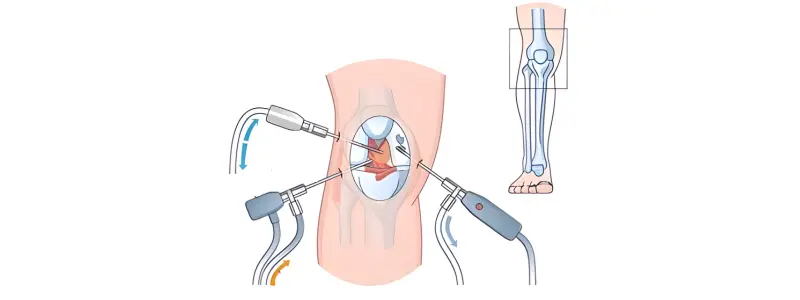
Each knee has two menisci: C-shaped pads of cartilage between the thigh bone and the shin bone that cushion the knee and spread the load across the joint. A meniscus can tear suddenly during a twist, or gradually with age as the tissue weakens.
Not every meniscus tear needs surgery. When surgery is needed, the aim is to keep as much of the meniscus as possible, by repairing the tear when it is suitable for repair, or by trimming only the part that cannot heal.
At PMG Hospital, Gota, meniscus repair and partial meniscectomy are performed arthroscopically (keyhole surgery). This page explains how the meniscus tears, the symptoms, when surgery is needed, repair or trimming, the procedure, recovery, risks and cost factors.
What Is the Meniscus, and How Does It Tear?
Each knee has an inner (medial) and an outer (lateral) meniscus. They act as shock absorbers, help to keep the knee stable and protect the cartilage on the ends of the bones.
There are two broad types of tear. An acute tear happens suddenly, usually during a twisting injury in sport, and is often seen in younger people, sometimes together with an ACL tear. A degenerative tear develops gradually as the tissue weakens with age, often in middle-aged and older adults, and may occur with early arthritis.
The outer part of the meniscus has a blood supply (the "red zone") and has a better chance of healing. The inner part has little blood supply (the "white zone") and usually does not heal. The position and pattern of the tear help to decide whether it can be repaired.
Symptoms of a Meniscus Tear
- Pain along the inner or outer side of the knee joint
- Swelling that develops over a day or two after a twisting injury
- Locking or catching, or a feeling that something is stuck inside the knee
- Difficulty fully straightening or bending the knee
- A feeling that the knee gives way
Assessment of a Meniscus Tear
A meniscus repair doctor in Ahmedabad - an orthopaedic surgeon - assesses the knee before advising treatment:
- 1History and examination: how the injury happened, locking, swelling and tests of the meniscus and ligaments
- 2X-rays: to check for arthritis and other bone problems, especially in older patients
- 3MRI: to confirm the tear, its position and pattern, and to check the ligaments and cartilage
Meniscus Tear Treatment in Ahmedabad: Is Surgery Needed?
| Non-surgical treatment is usually tried first | Surgery may be advised |
|---|---|
| Small, stable tears | The knee locks or catches, or cannot be fully straightened |
| Degenerative tears in middle-aged and older adults, especially with arthritis | A tear suitable for repair in a younger, active person |
| Symptoms improving with physiotherapy | A meniscus tear together with an ACL tear |
| A meniscus root tear in a knee without severe arthritis | |
| Symptoms continuing despite proper non-surgical treatment |
Treatment Without Surgery
Non-surgical treatment includes physiotherapy to strengthen the muscles around the knee, changes to activities, pain-relief medicines used as advised by a doctor and, in some cases, injections. For degenerative tears, studies show that arthroscopic trimming usually gives little extra benefit compared with physiotherapy, and current guidelines advise against it in most cases. A meniscus repair treatment hospital in Ahmedabad should provide these non-surgical treatments as well as surgery.
Source: Siemieniuk RAC et al. BMJ. 2017;357:j1982.
Repair or Trimming of the Meniscus
| Meniscus repair | Partial meniscectomy (trimming) | |
|---|---|---|
| What is done | The torn edges are stitched so that the tissue can heal | The torn part that cannot heal is trimmed away |
| Usually suitable for | Tears in the outer part with a blood supply, some root and other repairable tears, usually in younger patients and often with ACL reconstruction | Tears that cannot heal because of their position, pattern or the condition of the tissue |
| Meniscus kept | As much as possible | As much healthy meniscus as possible |
| Recovery | Slower, with protection of the repair for several weeks | Quicker |
| Long term | Some repaired tears do not heal and need further surgery | Removing a large part of the meniscus increases the risk of arthritis later |
Repair is preferred when the tear is suitable, because keeping the meniscus helps protect the knee in the long term. The final decision between repair and trimming is often made during the arthroscopy, when the tear can be seen directly.
Meniscus Repair Surgery in Ahmedabad: Step by Step
The main steps are similar in any meniscus repair surgery hospital in Ahmedabad:
- 1Anaesthesia: spinal or general anaesthesia
- 2Arthroscopy: two or more small cuts are made, and the knee is inspected with a camera
- 3Treatment: the tear is stitched with special repair devices or sutures (repair), or the torn part is trimmed (partial meniscectomy); other problems, such as an ACL tear, may be treated at the same time
- 4Closure: the cuts are closed and dressed; a brace may be used after a repair
- 5Going home: many patients go home the same day
Recovery After Meniscus Surgery
| Procedure | Usual recovery |
|---|---|
| Partial meniscectomy (trimming) | Walking the same day or the next day; daily activities over a few weeks; sport when strength and movement have recovered |
| Meniscus repair | Weight-bearing or bending limited for several weeks, often with a brace; deep squatting avoided for a few months; return to sport usually after about four to six months |
This is a general guide. Recovery depends on the type of tear, whether other procedures were done and how regularly the exercises are done.
Risks and Possible Complications
Meniscus surgery is a common operation, but no surgery is without risk. The surgeon explains these risks before taking consent.
- Infection of the wound or inside the joint, which is uncommon but may need further surgery
- Bleeding into the joint (haemarthrosis) or swelling that takes time to settle
- Blood clots in the leg veins (deep vein thrombosis) or lungs (pulmonary embolism)
- Stiffness or loss of movement
- Numbness of the skin around the incisions
- Injury to nerves or blood vessels, which is rare
- Continuing pain in some patients
- Anaesthesia-related and general medical risks
- Failure of a repair to heal, or a new tear, which may need further surgery
- Arthritis later in life, which is more likely when a large part of the meniscus has been removed
Meniscus Repair Surgery Hospital in Ahmedabad
When choosing a meniscus repair hospital in Ahmedabad, check that the treating surgeon is a qualified orthopaedic surgeon with valid medical council registration, that the hospital regularly performs this operation, how infection is prevented, which implants and tests are available, what physiotherapy and follow-up are provided, and what the written estimate includes.
Look beyond general phrases such as "a meniscus repair hospital with modern facilities" and ask which facilities are actually available on site.
Meniscus Surgery Cost in Ahmedabad
- Repair or trimming of the meniscus
- The repair devices used
- Any other treatment needed in the knee
- The type of anaesthesia
- Day-care or the length of hospital stay, and room category
- Physiotherapy and follow-up
A written, itemised estimate can be requested from the hospital after assessment.
Insurance
- Medically necessary meniscus surgery is generally covered under health insurance policies, subject to policy terms, waiting periods and insurer approval
- Some policies have limits on room rent or implant costs; check these with your insurer before surgery
- Ask the hospital whether cashless treatment is available with your insurer, and which documents are needed
Meniscus Repair Doctor in Ahmedabad
A meniscus tear is assessed and treated by an orthopaedic surgeon, usually one with training in arthroscopy and knee sports injuries. A family physician may see you first for knee pain, but the decision between physiotherapy, repair and trimming is made by the orthopaedic surgeon after examination and MRI. Other professionals help at different stages:
| Doctor or therapist | Role in meniscus care |
|---|---|
| Family physician | First assessment of knee pain; refers to an orthopaedic surgeon when a tear is suspected |
| Orthopaedic surgeon | Examines the knee, decides on non-surgical treatment or surgery, and performs the arthroscopy |
| Radiologist | Performs and reports X-rays and the MRI that shows the tear |
| Anaesthetist | Gives spinal or general anaesthesia for the arthroscopy |
| Physiotherapist | Leads non-surgical treatment, and the exercises and return to activity after surgery |
Meniscus Repair Surgery Doctor in Ahmedabad
The choice between repair and trimming affects both recovery and the long-term health of the knee. Before agreeing to surgery, it is reasonable to ask your meniscus repair surgery doctor in Ahmedabad:
- Where exactly is my tear, and what pattern does the MRI show?
- Is my tear likely to be repairable, or will it probably need trimming?
- If the decision is made during the arthroscopy, what will be done in each case?
- Is it a root tear, and how does that change the plan?
- Is there an ACL tear or cartilage damage, and will it be treated in the same operation?
- Will I need a brace and crutches after surgery, and for how long?
- When can I squat, sit cross-legged or return to my sport?
- What is the chance that a repair does not heal, and what would happen then?
Meniscus Repair Treatment Hospital in Ahmedabad
Meniscus surgery is usually a day-care or short-stay arthroscopy, but the result also depends on accurate imaging and months of guided exercise. These are the facilities that matter most:
| Facility | Why it matters |
|---|---|
| Access to MRI | Shows the position and pattern of the tear and other injuries in the knee |
| Operation theatre suitable for arthroscopy, with strict infection control | Infection inside the knee joint is uncommon but serious |
| Arthroscopy equipment and meniscus repair devices | Allow the tear to be repaired when suitable, not only trimmed |
| Anaesthesia services | Needed for spinal or general anaesthesia |
| Physiotherapy service | Needed for non-surgical treatment and for protected recovery after a repair |
The facilities available at PMG Hospital are listed further below on this page.
Treating Surgeon
At PMG Hospital, meniscus surgery is performed by:
| Detail | Information |
|---|---|
| Name | Dr. Hiren Patel |
| Qualification | MS (Ortho), B.J. Medical College, Ahmedabad |
| Specialty | Orthopaedics |
| Designation | Director & Head Joint Replacement Surgeon, PMG Hospital |
| Registration status | Registered Medical Practitioner |
| Registration number | Gujarat Medical Council Reg. No. G-20583 |
| OPD availability | Monday to Saturday, 10:00 AM - 8:00 PM |
Facilities at PMG Hospital
- Orthopaedic OPD, Monday to Saturday
- Emergency and trauma care, 24×7
- Orthopaedic physiotherapy centre
Frequently Asked Questions
When should I see a doctor about a knee problem?
See an orthopaedic surgeon if the knee locks, catches, cannot fully straighten, swells after a twisting injury, or keeps giving way, or if pain does not settle with rest and physiotherapy. A knee that is locked and cannot be straightened needs prompt assessment.
Does every meniscus tear need surgery?
No. Small, stable tears and degenerative tears in middle-aged and older adults often improve with physiotherapy, activity changes and pain-relief medicines. Surgery is mainly considered when a tear makes the knee lock or catch, when a repairable tear is found in a younger, active person, or when symptoms continue despite proper non-surgical treatment.
What is the difference between meniscus repair and meniscectomy?
In a meniscus repair, the torn edges are stitched so that the tissue can heal, keeping the meniscus. In a partial meniscectomy, the torn part that cannot heal is trimmed away, and as much healthy meniscus as possible is kept. Repair is preferred when the tear is suitable, because keeping the meniscus helps protect the knee in the long term.
Can a meniscus tear heal on its own?
It depends on where the tear is. The outer part of the meniscus has a blood supply, and small tears there can sometimes heal, while the inner part has little blood supply and tears there usually do not heal. Many tears that do not heal still stop causing symptoms with physiotherapy.
Is arthroscopy helpful for a degenerative meniscus tear?
For degenerative meniscus tears in middle-aged and older adults, especially when there is arthritis, studies show that arthroscopic trimming usually gives little extra benefit compared with physiotherapy, and current guidelines advise against it in most cases. Surgery may still be considered when the knee truly locks or when symptoms do not improve with proper non-surgical treatment.
Is meniscus surgery done as keyhole surgery?
Yes, usually. It is done arthroscopically, through small cuts around the knee; some repairs need an additional small cut at the side or back of the knee. Many patients go home the same day.
How long does recovery take after meniscus surgery?
After trimming (partial meniscectomy), most people walk the same day or the next day and return to daily activities over a few weeks. After a repair, weight-bearing or bending of the knee is usually limited for several weeks to protect the stitches, and a return to sport usually takes about four to six months.
What facilities should a hospital have for meniscus surgery?
It should have an operation theatre suitable for arthroscopic surgery with strict infection-control practices, arthroscopy equipment, meniscus repair devices, anaesthesia services, access to MRI, and a physiotherapy service.
What decides the cost of meniscus surgery?
The cost depends on whether the meniscus is repaired or trimmed, the repair devices used, any other treatment needed in the knee, the type of anaesthesia, day-care or the length of stay, room category and physiotherapy. A written, itemised estimate can be requested from the hospital after assessment.
Contact and Location
PMG Hospital
3rd Floor, Athena Avenue, B/H Jaguar Showroom, Nr. Eulogia Inn Hotel, Gota, Ahmedabad, India
- Phone / WhatsApp:
- +91 96627 70141
- OPD:
- Mon – Sat · 10:00 AM – 8:00 PM
- Emergency and trauma care:
- 24×7