
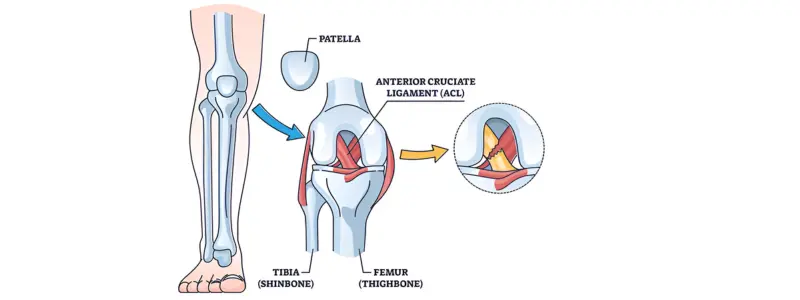
The anterior cruciate ligament (ACL) is one of the main ligaments that keep the knee stable. A torn ACL can make the knee give way when turning, pivoting or going down stairs. ACL reconstruction is an operation in which the torn ligament is replaced with a tendon graft to make the knee stable again.
Not every ACL tear needs surgery. The decision depends on how unstable the knee is, the person's activity level and whether other parts of the knee are also injured.
At PMG Hospital, Gota, ACL reconstruction is performed arthroscopically (keyhole surgery). This page explains how the ACL tears, the signs of a tear, when surgery is needed, graft options, the procedure, recovery, return to sport, risks and cost factors.
What Is the ACL, and How Does It Tear?
The knee has four main ligaments: two collateral ligaments on the sides of the knee - the medial collateral ligament (MCL) and the lateral collateral ligament (LCL) - and two cruciate ligaments inside the joint - the ACL and the posterior cruciate ligament (PCL). The ACL runs diagonally through the middle of the knee and stops the shin bone from moving too far forward and twisting under the thigh bone.
The ACL usually tears during a sudden twist, pivot, change of direction or awkward landing from a jump, often during sports such as football, cricket, kabaddi, basketball and badminton. It can also tear in a fall or a road accident. The meniscus, cartilage or other ligaments may be injured at the same time.
Signs of an ACL Tear
- A "pop" felt or heard at the time of injury
- Rapid swelling of the knee within a few hours
- Pain and difficulty continuing the activity or sport
- The knee giving way, especially when turning, pivoting or going down stairs
- Reduced movement of the knee in the days after the injury
Assessment of an ACL Injury
An ACL reconstruction doctor in Ahmedabad - an orthopaedic surgeon - assesses the knee before advising treatment:
- 1History and examination: how the injury happened, giving way, swelling, and tests of the stability of the knee
- 2X-rays: to look for fractures and other bone injuries
- 3MRI: to confirm the ACL tear and to check the meniscus, cartilage and other ligaments
- 4Fitness for surgery: blood tests and other checks as needed
Does Every ACL Tear Need Surgery?
| Reconstruction is usually advised | Non-surgical treatment may be suitable | |
|---|---|---|
| Activity | Sports that involve twisting, jumping or sudden changes of direction; physically demanding work | Less active lifestyle; activities without twisting |
| Stability | The knee gives way in daily life or sport | The knee feels stable after physiotherapy |
| Other injuries | A repairable meniscus tear or other ligament injuries | An isolated ACL tear |
Treatment Without Surgery
Non-surgical treatment is a structured physiotherapy programme to restore movement, strengthen the thigh and hip muscles and improve balance and control, along with changes to activities that involve twisting. If the knee still gives way, reconstruction can be considered later. An ACL reconstruction treatment hospital in Ahmedabad should provide this rehabilitation as well as surgery.
In children and teenagers whose growth plates are still open, an unstable knee can damage the meniscus and cartilage, so reconstruction is often advised, using a technique planned to protect the growth plates.
What Is ACL Reconstruction?
In most cases, a torn ACL cannot simply be stitched back together. In ACL reconstruction, the torn ligament is replaced with a tendon graft that is passed through small tunnels in the thigh bone and shin bone and fixed in place. Over the following months, the graft heals into the bone and gradually becomes a new ligament.
Surgery is usually done once the swelling has settled and the knee has regained good movement, often after a short course of physiotherapy before surgery. Earlier surgery may be advised when there is also a meniscus tear that can be repaired or another injury that needs treatment.
Graft Options for ACL Reconstruction
| Graft | Taken from | Points to consider |
|---|---|---|
| Hamstring tendon | Tendons at the back of the thigh | Commonly used; small cut; some temporary weakness of the hamstring muscles |
| Patellar tendon (bone–patellar tendon–bone) | The central part of the tendon below the kneecap, with a small piece of bone at each end | Bone-to-bone healing; more pain when kneeling than with other grafts |
| Quadriceps tendon | The tendon above the kneecap | Increasingly used; a thick graft |
A donor tendon (allograft) is used occasionally, for example in revision surgery or when several ligaments need reconstruction. The surgeon explains which graft suits the patient's knee, sport and activity level.
ACL Reconstruction Surgery in Ahmedabad: Step by Step
The main steps are similar in any ACL reconstruction surgery hospital in Ahmedabad:
- 1Anaesthesia: spinal or general anaesthesia, often with a nerve block for pain relief
- 2Arthroscopy: the knee is inspected with a camera to confirm the ACL tear and check the meniscus and cartilage; a meniscus tear may be repaired or trimmed at the same time
- 3Graft harvest: the chosen tendon is taken through a small cut and prepared
- 4Tunnels: small tunnels are drilled in the thigh bone and shin bone at the positions of the original ligament
- 5Graft fixation: the graft is passed through the tunnels and fixed with screws, buttons or other fixation devices
- 6Closure: the cuts are closed and dressed; many patients go home the same day or after a short stay
Recovery and Return to Sport
| Time | What usually happens |
|---|---|
| First days | Walking with crutches; a brace in some patients; exercises to straighten the knee and activate the thigh muscles |
| Weeks 1–6 | Swelling settles; full straightening returns and bending improves steadily; walking without crutches; early strengthening |
| Months 2–4 | Progressive strengthening and balance work; straight-line jogging usually at around three to four months, when allowed |
| Months 4–9 | Running, jumping and sport-specific training |
| About 9–12 months | Return to sports that involve twisting or jumping, only after strength, balance and control tests are passed |
The graft takes many months to heal and become strong. Returning to sport too early, or before strength and control have recovered, increases the risk of a new injury. Physiotherapy is a central part of recovery.
Risks and Possible Complications
ACL reconstruction is a common operation, but no surgery is without risk. The surgeon explains these risks before taking consent.
- Infection of the wound or inside the joint, which is uncommon but may need further surgery
- Bleeding into the joint (haemarthrosis) or swelling that takes time to settle
- Blood clots in the leg veins (deep vein thrombosis) or lungs (pulmonary embolism)
- Stiffness or loss of movement
- Numbness of the skin around the incisions
- Injury to nerves or blood vessels, which is rare
- Continuing pain in some patients
- Anaesthesia-related and general medical risks
- Failure or tear of the graft, or a tear of the ACL in the other knee
- Pain at the front of the knee or when kneeling, especially after a patellar tendon graft
- Arthritis later in life, which is more likely after an ACL injury, especially when the meniscus or cartilage is also damaged
ACL Reconstruction Surgery Hospital in Ahmedabad
When choosing an ACL reconstruction hospital in Ahmedabad, check that the treating surgeon is a qualified orthopaedic surgeon with valid medical council registration, that the hospital regularly performs this operation, how infection is prevented, which implants and tests are available, what physiotherapy and follow-up are provided, and what the written estimate includes.
Look beyond general phrases such as "an ACL reconstruction hospital with modern facilities" and ask which facilities are actually available on site.
ACL Reconstruction Surgery Cost in Ahmedabad
- The graft and the fixation implants used
- Any additional treatment of the meniscus or cartilage
- The type of anaesthesia
- Length of hospital stay and room category
- Physiotherapy and follow-up
A written, itemised estimate can be requested from the hospital after assessment.
Insurance
- Medically necessary ACL reconstruction is generally covered under health insurance policies, subject to policy terms, waiting periods and insurer approval
- Some policies have limits on room rent or implant costs; check these with your insurer before surgery
- Ask the hospital whether cashless treatment is available with your insurer, and which documents are needed
ACL Reconstruction Doctor in Ahmedabad
An ACL tear is diagnosed and treated by an orthopaedic surgeon, usually one who performs arthroscopic (keyhole) knee surgery. A family physician or an emergency doctor may see the injury first, but the decision about reconstruction is made by the orthopaedic surgeon after examination and an MRI. Different professionals are involved at different stages:
| Doctor or therapist | Role in ACL injury care |
|---|---|
| Family physician or emergency doctor | First examination after a knee injury; refers to an orthopaedic surgeon when a ligament tear is suspected |
| Orthopaedic surgeon (arthroscopy and sports injuries) | Examines the knee, confirms the ACL tear, advises physiotherapy or reconstruction, and performs the operation |
| Radiologist | Performs and reports the X-rays and MRI |
| Anaesthetist | Checks fitness for surgery, gives spinal or general anaesthesia and plans pain relief such as a nerve block |
| Physiotherapist | Guides exercises before and after surgery, and the strength, balance and control tests before return to sport |
ACL Reconstruction Surgery Doctor in Ahmedabad
Before agreeing to the operation, it is reasonable to ask your ACL reconstruction surgery doctor in Ahmedabad a few clear questions about your own knee. The answers help you understand the plan and give informed consent.
- Is my ACL tear complete or partial, and are the meniscus, cartilage or other ligaments also injured?
- Is reconstruction advised for my knee and activity level, or can a structured physiotherapy programme be tried first?
- Which graft do you plan to use in my case, and what are its drawbacks for me?
- If a meniscus tear is found during surgery, will it be repaired or trimmed, and how would that change my recovery?
- When should the operation be done, and what physiotherapy do I need before it?
- Will I need a brace or crutches, and for how long?
- When can I drive, and return to work or college?
- What does the written estimate include, and does my insurance policy cover the implants and physiotherapy?
ACL Reconstruction Treatment Hospital in Ahmedabad
Treatment for an ACL tear continues for months after the operation, so the hospital should support the whole pathway - assessment, surgery and rehabilitation. These are the facilities that matter most:
| Facility | Why it matters |
|---|---|
| Orthopaedic OPD and X-ray | Examination and first imaging after a knee injury |
| Access to MRI | Confirms the ACL tear and shows injuries to the meniscus, cartilage and other ligaments |
| Operation theatre for arthroscopic surgery, with infection-control practices | Infection inside the joint is uncommon but serious |
| Arthroscopy equipment and fixation implants | Needed for graft fixation and for treating the meniscus during the same operation |
| Anaesthesia services | Spinal or general anaesthesia, and nerve blocks for pain relief |
| Physiotherapy service | Supports the months of rehabilitation and the tests before return to sport |
| Follow-up visits | Movement, strength and knee stability are checked over the following months |
The facilities available at PMG Hospital are listed further below on this page.
Treating Surgeon
At PMG Hospital, ACL reconstruction is performed by:
| Detail | Information |
|---|---|
| Name | Dr. Hiren Patel |
| Qualification | MS (Ortho), B.J. Medical College, Ahmedabad |
| Specialty | Orthopaedics |
| Designation | Director & Head Joint Replacement Surgeon, PMG Hospital |
| Registration status | Registered Medical Practitioner |
| Registration number | Gujarat Medical Council Reg. No. G-20583 |
| OPD availability | Monday to Saturday, 10:00 AM - 8:00 PM |
Facilities at PMG Hospital
- Orthopaedic OPD, Monday to Saturday
- Emergency and trauma care, 24×7
- Orthopaedic physiotherapy centre
Frequently Asked Questions
When should I see a doctor about a knee injury?
See an orthopaedic surgeon if the knee popped and swelled quickly after a twist or fall, if it gives way when turning or on stairs, or if pain and swelling do not settle. An examination and usually an MRI show whether the ACL is torn and whether the meniscus, cartilage or other ligaments are also injured.
Does every ACL tear need surgery?
No. Younger, active people who play sports that involve twisting, jumping or sudden changes of direction, or whose knee gives way in daily life, are usually advised reconstruction. People who are less active and whose knee feels stable after a structured physiotherapy programme may manage well without surgery. The decision is made after examination and scans.
Can a torn ACL heal on its own?
A completely torn ACL usually does not heal back to normal on its own. Some people with a partial tear, and some less active people with a complete tear, manage well with physiotherapy. A knee that keeps giving way usually needs reconstruction to become stable.
Which graft is used for ACL reconstruction?
The new ligament is usually made from the patient's own hamstring, patellar or quadriceps tendon. Each has advantages and disadvantages, and there is no single graft that suits everyone. The surgeon explains which graft suits the patient's knee, sport and activity level.
Is ACL reconstruction done by keyhole surgery?
Yes. ACL reconstruction is done arthroscopically, through small cuts, with an additional small cut to take the tendon graft. Many patients go home the same day or after a short hospital stay.
How long does recovery take, and when can I return to sport?
Most people walk without crutches within a few weeks. Straight-line jogging usually starts at around three to four months, and a return to sports that involve twisting or jumping usually takes about nine months to a year and should happen only after strength, balance and control tests are passed. Returning too early increases the risk of a new injury.
Will my knee be normal again after ACL reconstruction?
Most people regain a stable knee for daily activities, and many return to sport. Some do not return to the same level of sport, some have kneeling pain or stiffness, and some, especially young people who return to sports that involve twisting, tear the graft or the ACL of the other knee. The risk of arthritis later in life is higher after an ACL injury, especially when the meniscus or cartilage is also damaged.
What facilities should a hospital have for ACL reconstruction?
It should have an operation theatre suitable for arthroscopic surgery with strict infection-control practices, arthroscopy equipment, the fixation implants needed, anaesthesia services, X-ray and access to MRI, and a physiotherapy service for the months of rehabilitation after surgery.
What decides the cost of ACL reconstruction?
The cost depends on the graft, the fixation implants, any additional treatment of the meniscus or cartilage, the type of anaesthesia, the length of hospital stay, room category and physiotherapy. A written, itemised estimate can be requested from the hospital after assessment.
Contact and Location
PMG Hospital
3rd Floor, Athena Avenue, B/H Jaguar Showroom, Nr. Eulogia Inn Hotel, Gota, Ahmedabad, India
- Phone / WhatsApp:
- +91 96627 70141
- OPD:
- Mon – Sat · 10:00 AM – 8:00 PM
- Emergency and trauma care:
- 24×7