
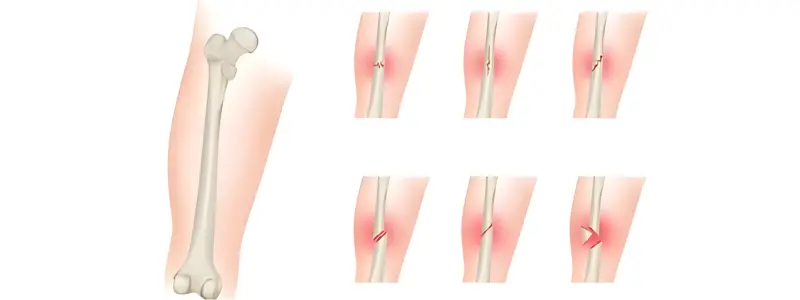
Injuries around the knee range from a fracture of the kneecap after a fall to complex fractures of the upper end of the shin bone or the lower end of the thigh bone after a road accident. The knee bears the body's weight, so fractures that involve the joint surface need careful treatment to reduce the risk of stiffness, instability and arthritis later.
Some knee fractures can be treated in a brace or cast. Fractures that are displaced, are unstable or involve a step in the joint surface usually need surgery.
At PMG Hospital, Gota, emergency and trauma care is available 24×7, and knee fractures and injuries are treated with both non-surgical care and surgery. This page explains the types of knee injury, when surgery is needed, how fractures are fixed, recovery, risks and cost factors.
Fractures and Injuries Around the Knee
| Injury | What it is |
|---|---|
| Tibial plateau fracture | A fracture of the upper end of the shin bone, involving the knee joint surface |
| Distal femur fracture | A fracture of the lower end of the thigh bone, just above the knee |
| Patella (kneecap) fracture | A fracture of the kneecap |
| Quadriceps or patellar tendon rupture | A tear of the tendon above or below the kneecap, so the knee cannot be straightened actively |
| Periprosthetic fracture | A fracture around an existing knee replacement |
| Fracture with ligament or meniscus injury | A fracture together with a torn ligament or meniscus |
| Knee dislocation | The knee is forced out of joint, tearing several ligaments; an emergency, because the main artery behind the knee can be injured |
Related pages: Knee dislocation · Knee replacement · Bone fracture surgery
Why Fractures Into the Knee Joint Need Careful Treatment
When a fracture runs into the joint surface of the knee, a step or gap left in the surface, or poor alignment of the leg, can change how the joint takes load and increase the risk of arthritis later. The cartilage may also be damaged at the time of injury. For this reason, displaced fractures of the joint surface are usually put back into position as accurately as possible and fixed firmly, so that the knee can start moving early.
After high-energy injuries, the soft tissues around the knee may be badly swollen. Fixation is then sometimes done in stages: a temporary external fixator first, and definitive fixation with plates and screws once the swelling has settled.
Assessment of a Knee Injury
A knee trauma doctor in Ahmedabad - an orthopaedic surgeon - assesses the injury before advising treatment:
- 1Examination: the knee, the skin, the circulation of the foot and the nerves, and signs of compartment syndrome in the leg
- 2X-rays: of the knee and, when needed, the whole leg
- 3CT scan: for most fractures that involve the joint surface, to plan treatment
- 4MRI: in selected cases, to assess the ligaments and meniscus
Knee Fracture Treatment in Ahmedabad: Is Surgery Needed?
| Often treated without surgery | Surgery is usually considered |
|---|---|
| Fractures that are not displaced and are stable | Displaced or unstable fractures |
| Fractures with no step in the joint surface | Fractures with a step or gap in the joint surface |
| Undisplaced kneecap fractures in which the knee can still be straightened actively | Displaced kneecap fractures, those in which the knee cannot be straightened actively, and tendon ruptures |
| Open fractures, fractures around a knee replacement, and fractures with a blood vessel injury |
A knee trauma treatment hospital in Ahmedabad should provide treatment in a brace or cast with close follow-up, as well as surgery, because not every knee fracture needs an operation.
Knee Fracture Surgery in Ahmedabad: Step by Step
The main steps are similar in any knee trauma surgery hospital in Ahmedabad:
- 1Anaesthesia: spinal or general anaesthesia, often with a nerve block for pain relief
- 2Reduction: the fracture is put back into position, with the joint surface restored as accurately as possible, using X-ray imaging during surgery
- 3Fixation: plates and screws for most tibial plateau and distal femur fractures; a nail for some distal femur fractures; wires, screws or plates for kneecap fractures; tendon repair for tendon ruptures
- 4Associated injuries: a torn meniscus may be repaired at the same time; some ligament injuries are treated together with the fracture and others later
- 5Closure: the wound is closed, and a brace may be applied
In selected older people with a fracture around the knee that is broken into several pieces, or with existing arthritis or very weak bone, a knee replacement may be considered instead of fixation.
Recovery After Knee Fracture Surgery
| Time | What usually happens |
|---|---|
| First days | Pain control; early, protected movement of the knee as advised, to reduce stiffness |
| First 6–12 weeks | Weight on the leg limited for many fractures of the joint surface, until X-rays show healing; walking with crutches or a walker |
| About 3 months | Weight-bearing and walking increase as the fracture heals |
| 6 months to a year | Strength, movement and walking continue to improve |
After some kneecap fractures, walking may be allowed in a brace with the knee kept straight. The surgeon advises what is safe for each fracture.
Risks and Possible Complications
Knee fractures and their treatment carry risks. The surgeon explains these before taking consent.
- Stiffness of the knee
- Arthritis of the knee later in life, after fractures that involve the joint surface
- Infection and wound-healing problems, especially after high-energy injuries
- Compartment syndrome (a dangerous rise in pressure in the leg muscles), which needs emergency surgery, especially after tibial plateau fractures
- Delayed healing, non-healing or poor position of the fracture, or loss of position before healing
- Injury to nerves or blood vessels, including the nerve on the outer side of the knee (common peroneal nerve), which is uncommon
- Blood clots in the leg veins or lungs
- Irritation from the implant, especially at the kneecap, which may need to be removed later
- Anaesthesia-related and general medical risks
Knee Trauma Hospital in Ahmedabad
When choosing a knee trauma hospital in Ahmedabad, check that the treating surgeon is a qualified orthopaedic surgeon with valid medical council registration, that the hospital regularly treats these injuries, whether emergency care, X-rays and other scans are available at all hours, how infection is prevented, which implants are available, what physiotherapy and follow-up are provided, and what the written estimate includes.
Look beyond general phrases such as "a knee trauma hospital with modern facilities" and ask which facilities are actually available on site.
Knee Trauma Treatment Cost in Ahmedabad
- The type of fracture and the implants used
- Whether the fracture is open, and whether staged surgery or arthroscopy is needed
- The type of anaesthesia
- Length of hospital stay and room category
- Physiotherapy and follow-up
A written, itemised estimate can be requested from the hospital after assessment.
Insurance
- Treatment of knee injuries is generally covered under health insurance policies, subject to policy terms and insurer approval
- Some policies have limits on room rent or implant costs; check these with your insurer
- Ask the hospital whether cashless treatment is available with your insurer, and whether the hospital is empanelled under the government health scheme that applies to you
Knee Trauma Doctor in Ahmedabad
Fractures and serious injuries around the knee are treated by an orthopaedic surgeon. An emergency doctor usually sees the patient first, but the decision between a brace, a cast or surgery is made by the orthopaedic surgeon after X-rays and, often, a CT scan. Other doctors are involved when needed:
| Doctor or therapist | Role in knee trauma care |
|---|---|
| Emergency doctor | First assessment, pain relief, splinting, and checks of the circulation and nerves |
| Orthopaedic surgeon | Plans treatment, fixes the fracture or repairs the tendon, and leads follow-up |
| Radiologist | Performs and reports X-rays, CT scans and MRI |
| Anaesthetist | Gives spinal or general anaesthesia and nerve blocks for pain relief |
| Vascular surgeon | Treats an injury to the main artery behind the knee, as an emergency |
| Plastic surgeon | Covers skin and soft-tissue loss in some open fractures |
| Physiotherapist | Guides knee movement, walking with support and strengthening as the fracture heals |
Knee Trauma Surgery Doctor in Ahmedabad
Knee fracture surgery is often planned within a few days of the injury, so there is usually time for a short discussion. It is reasonable to ask your knee trauma surgery doctor in Ahmedabad:
- What type of fracture is it, and does it involve the joint surface?
- What did the CT scan show, and how does it change the plan?
- Will the fracture be fixed in one operation, or first held in a temporary external fixator?
- Which implant will be used, and might it need to be removed later?
- How will the swelling and the skin be managed before surgery?
- Which exercises should I do in the first weeks to reduce stiffness?
- What are the main risks in my case, such as infection, compartment syndrome or blood clots?
- Which warning signs after discharge need urgent attention?
Knee Trauma Treatment Hospital in Ahmedabad
Knee injuries often happen outside OPD hours and may need a CT scan and surgery within days, so the hospital where they are treated should be equipped for each stage. These are the facilities that matter most:
| Facility | Why it matters |
|---|---|
| 24×7 emergency and trauma care | Injuries happen at any hour and need early splinting and assessment |
| X-ray and access to CT scanning | Show the fracture pattern and the joint surface, to plan treatment |
| Operation theatre with X-ray imaging during surgery | Allows the fracture and joint surface to be restored and checked during the operation |
| A range of implants and arthroscopy equipment | Different fractures need plates, screws, nails or wires, and some need arthroscopy |
| Anaesthesia services and post-operative monitoring | Needed for safe surgery and early detection of complications such as compartment syndrome |
| Physiotherapy service | Early movement reduces stiffness while the fracture heals |
The facilities available at PMG Hospital are listed further below on this page.
Treating Surgeon
At PMG Hospital, knee fracture surgery is performed by:
| Detail | Information |
|---|---|
| Name | Dr. Hiren Patel |
| Qualification | MS (Ortho), B.J. Medical College, Ahmedabad |
| Specialty | Orthopaedics |
| Designation | Director & Head Joint Replacement Surgeon, PMG Hospital |
| Registration status | Registered Medical Practitioner |
| Registration number | Gujarat Medical Council Reg. No. G-20583 |
| OPD availability | Monday to Saturday, 10:00 AM - 8:00 PM |
Facilities at PMG Hospital
- Orthopaedic OPD, Monday to Saturday
- Emergency and trauma care, 24×7
- Orthopaedic physiotherapy centre
Frequently Asked Questions
When should I see a doctor after a knee injury?
See an orthopaedic surgeon promptly after a knee injury with pain, swelling, deformity or inability to put weight on the leg. Go to the nearest emergency facility immediately if the knee looks out of shape, the foot is numb, cold or pale, a bone has broken through the skin, or pain keeps increasing.
What is a tibial plateau fracture?
It is a fracture of the upper end of the shin bone (tibia), which forms the lower part of the knee joint. Because it involves the joint surface, a displaced fracture usually needs surgery to restore the surface as accurately as possible. It can follow a high-energy injury, or a minor fall in a person with weak bones.
Does a knee fracture always need surgery?
No. Fractures that are not displaced and are stable can often be treated in a brace or cast with close follow-up and X-rays. Surgery is usually considered when the fracture is displaced or unstable, involves a step in the joint surface, is open, or occurs around a knee replacement.
Will I get arthritis after a knee fracture?
There is a risk of arthritis after a fracture that involves the knee joint, because the cartilage may be damaged at the time of injury and any unevenness of the joint surface can increase wear. Accurate treatment of the fracture reduces, but cannot always remove, this risk.
Can cartilage or ligament damage be treated at the same time?
Sometimes. A torn meniscus found during fracture surgery may be repaired at the same time. Some ligament injuries are treated together with the fracture, while others are treated later, once the fracture has healed and movement has returned.
How long before I can put weight on my knee?
After many fractures that involve the joint surface, weight on the leg is limited for about six to twelve weeks, until the fracture shows healing on X-rays. During this time, the knee is usually moved gently to reduce stiffness. After some kneecap fractures, walking may be allowed in a brace with the knee kept straight. The surgeon advises what is safe for each fracture.
How long does recovery take after a knee fracture?
Many fractures around the knee heal in about three months, and strength, movement and walking continue to improve over six months to a year. Recovery is slower after complex fractures and high-energy injuries.
What facilities should a hospital have for knee fractures?
It should have 24×7 emergency care, X-ray and access to CT scanning, an operation theatre suitable for fracture surgery with X-ray imaging during surgery and strict infection-control practices, a range of implants, arthroscopy equipment, anaesthesia services and physiotherapy.
What decides the cost of knee fracture treatment?
The cost depends on the type of fracture, the implants used, whether the fracture is open, whether arthroscopy or staged surgery is needed, the type of anaesthesia, the length of hospital stay, room category and physiotherapy. A written, itemised estimate can be requested from the hospital after assessment.
Contact and Location
PMG Hospital
3rd Floor, Athena Avenue, B/H Jaguar Showroom, Nr. Eulogia Inn Hotel, Gota, Ahmedabad, India
- Phone / WhatsApp:
- +91 96627 70141
- OPD:
- Mon – Sat · 10:00 AM – 8:00 PM
- Emergency and trauma care:
- 24×7