
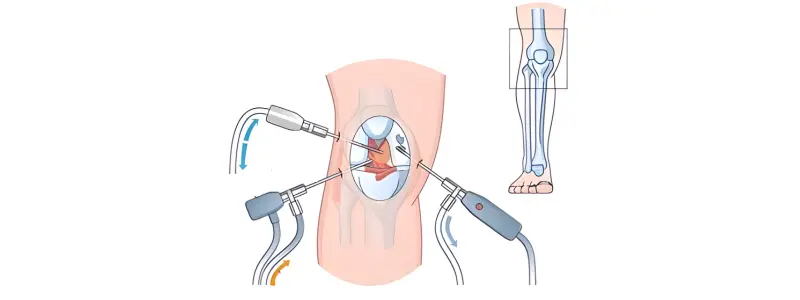
Arthroscopy is keyhole surgery of a joint. Through small cuts, a thin camera and fine instruments are used to look inside the joint and treat problems such as torn ligaments, a torn meniscus, damaged cartilage, loose fragments and some shoulder and hip problems.
Arthroscopy is usually considered when a joint problem has not settled with rest, medicines and physiotherapy, or when an injury has caused a problem that needs repair, such as a torn ligament or a meniscus tear that makes the knee lock.
At PMG Hospital, Gota, arthroscopic procedures on the knee, shoulder and hip are performed. This page explains what arthroscopy is, the procedures performed, when it is advised and when it is not, the operation, recovery, risks and cost factors.
What Is Arthroscopy (Keyhole Surgery)?
In arthroscopy, a thin tube containing a camera and light (the arthroscope) is passed into the joint through a small cut, usually less than one centimetre long. The joint is filled with sterile fluid so that it can be seen clearly, and the picture is shown on a screen. Fine instruments are passed through one or more other small cuts to repair or remove damaged tissue.
Because the cuts are small, arthroscopy usually causes less pain and a quicker early recovery than open surgery. However, the tissue that has been repaired, such as a ligament graft or a stitched meniscus, still needs the normal time to heal.
Which Joints Can Be Treated with Arthroscopy?
| Joint | Problems commonly treated with arthroscopy |
|---|---|
| Knee | Meniscus tears, ACL and PCL tears, cartilage damage, loose fragments |
| Shoulder | Rotator cuff tears, repeated dislocation, SLAP tears, biceps tendon problems, frozen shoulder, impingement and bursitis |
| Hip | Femoroacetabular impingement (FAI), labral tears, loose fragments |
| Ankle, elbow and wrist | Selected problems such as impingement, cartilage damage and loose fragments |
Arthroscopic Procedures at PMG Hospital
Knee
- ACL reconstruction - rebuilding a torn anterior cruciate ligament with a tendon graft
- PCL reconstruction - rebuilding a torn posterior cruciate ligament when it is needed
- Meniscus repair - stitching a torn meniscus, or trimming a tear that cannot heal
- Knee dislocation - reconstruction of several torn ligaments after the emergency treatment of a dislocated knee
- Cartilage restoration - treatment of a single, well-defined area of damaged joint cartilage
Shoulder
- Rotator cuff repair - reattaching torn rotator cuff tendons to the bone
- Biceps tenodesis - reattaching a damaged biceps tendon at a new position on the arm bone
- Shoulder dislocation - stabilising a shoulder that keeps dislocating
- SLAP tear repair - treating a tear of the labrum at the upper part of the shoulder socket
- Frozen shoulder - releasing the tight joint capsule when stiffness has not improved with other treatment
- Shoulder bursitis - removing inflamed tissue and, in selected patients, bone that narrows the space under the acromion, the bony tip of the shoulder (subacromial decompression)
Hip
- Hip arthroscopy - treatment of femoroacetabular impingement, labral tears and loose fragments in a hip without established arthritis
When Is Arthroscopy Recommended?
Arthroscopy may be advised when:
- A joint locks, catches or gives way because of a torn meniscus, a loose fragment or a torn ligament
- A ligament tear makes the knee or shoulder unstable during daily activities or sport
- Pain and loss of function continue despite rest, medicines, physiotherapy and, in some cases, injections, and a problem that can be treated has been found on examination and scans
When Arthroscopy Is Usually Not Helpful
For knee osteoarthritis without a mechanical problem such as true locking, arthroscopic washing out or trimming of the joint is not recommended, because studies show little or no lasting benefit compared with non-surgical treatment. The same applies to many degenerative meniscus tears in middle-aged and older adults. Weight control, exercise, physiotherapy and medicines are usually advised instead. Studies also show that subacromial decompression gives little extra benefit for shoulder impingement pain without a tendon tear.
Sources: Siemieniuk RAC et al. BMJ. 2017;357:j1982; National Institute for Health and Care Excellence (NICE) guideline NG226, 2022; Beard DJ et al. The Lancet. 2018;391:329–338.
Treatment Before Surgery
Many joint problems improve without surgery, with rest, changes to activities, physiotherapy, pain-relief medicines used as advised by a doctor and, in selected patients, injections. An arthroscopy treatment hospital in Ahmedabad should provide these non-surgical treatments as well as surgery, because not every joint problem needs an operation.
Keyhole vs Open Surgery
| Arthroscopy (keyhole) | Open surgery | |
|---|---|---|
| Cuts | Two or more small cuts | One larger cut |
| Disturbance of healthy tissue | Usually less | Usually more |
| Pain and scarring | Usually less | Usually more |
| Hospital stay | Many procedures are day-care or need a short stay | Often longer |
| Early recovery | Usually quicker | Usually slower |
Not every problem can be treated through keyhole surgery. Some operations need a small open cut, or a combination of arthroscopy and open surgery, and the surgeon explains which approach is suitable.
Assessment Before Surgery
An arthroscopy doctor in Ahmedabad - an orthopaedic surgeon - assesses the joint before advising surgery:
- 1History and examination: how the problem started, locking, giving way, swelling, movement and stability of the joint
- 2X-rays: to check the bones and look for arthritis
- 3MRI: to assess ligaments, the meniscus, cartilage, the labrum and tendons
- 4Fitness for surgery: blood tests and other checks as needed, depending on age and general health
- 5Medicines: blood thinners and some other medicines may need to be stopped or changed, only as advised by the doctor
Arthroscopy Surgery in Ahmedabad: Step by Step
The main steps are similar in any arthroscopy surgery hospital in Ahmedabad:
- 1Anaesthesia: spinal or general anaesthesia for knee arthroscopy; general anaesthesia for shoulder and hip arthroscopy, often with a nerve block for shoulder surgery
- 2Small cuts: two or more small cuts are made around the joint
- 3Inspection: the joint is filled with sterile fluid and inspected with the camera
- 4Treatment: damaged tissue is repaired, reconstructed or removed with fine instruments; some procedures use small anchors, screws or a tendon graft
- 5Closure: the cuts are closed with stitches or adhesive strips and covered with a dressing
- 6Going home: many patients go home the same day or the next day; some procedures need a longer stay
Recovery After Arthroscopy
| Procedure | Usual recovery |
|---|---|
| Trimming of a torn meniscus (partial meniscectomy) | Walking the same day or the next day; daily activities over a few weeks |
| Meniscus repair | Limited weight-bearing or bending for several weeks; return to sport after about four to six months |
| ACL or PCL reconstruction | Physiotherapy over several months; return to sports that involve twisting usually after about nine months to a year |
| Shoulder repairs (such as rotator cuff repair or stabilisation) | Sling for about four to six weeks; strength improves over several months |
| Hip arthroscopy | Crutches for a few weeks; graded return to sport over about three to six months |
This is a general guide. Recovery depends on the joint, the procedure, general health and how regularly the exercises are done. Physiotherapy is part of recovery after most arthroscopic procedures.
Risks and Possible Complications
Arthroscopy is a common operation, but no surgery is without risk. The surgeon explains these risks before taking consent.
- Infection of the wound or inside the joint, which is uncommon but may need further surgery
- Bleeding into the joint or swelling that takes time to settle
- Blood clots in the leg veins (deep vein thrombosis) or lungs (pulmonary embolism)
- Stiffness or loss of movement
- Numbness of the skin around the cuts
- Injury to nerves or blood vessels, which is rare
- Failure of a repair or a graft, or a new tear, which may need further surgery
- Continuing pain in some patients
- Anaesthesia-related and general medical risks
Risks specific to each procedure are explained on the related pages.
Arthroscopy Surgery Hospital in Ahmedabad
When choosing an arthroscopy hospital in Ahmedabad, check that the treating surgeon is a qualified orthopaedic surgeon with valid medical council registration, that the hospital regularly performs this operation, how infection is prevented, which implants and tests are available, what physiotherapy and follow-up are provided, and what the written estimate includes.
Look beyond general phrases such as "an arthroscopy hospital with modern facilities" and ask which facilities are actually available on site.
Arthroscopy Surgery Cost in Ahmedabad
- The joint and the procedure
- Implants, anchors or grafts used
- The type of anaesthesia
- Day-care or the length of hospital stay, and room category
- Other medical conditions and any extra care needed
- Physiotherapy and follow-up
A written, itemised estimate can be requested from the hospital after assessment.
Insurance
- Medically necessary arthroscopic surgery is generally covered under health insurance policies, subject to policy terms, waiting periods and insurer approval
- Some policies have limits on room rent or implant costs; check these with your insurer before surgery
- Ask the hospital whether cashless treatment is available with your insurer, and which documents are needed
Arthroscopy Doctor in Ahmedabad
Arthroscopy is performed by an orthopaedic surgeon who has trained in keyhole surgery of the joints. A family physician or an emergency doctor may see a joint problem or injury first, but the decision about arthroscopy is made by the orthopaedic surgeon after examination and scans. Different professionals are involved at different stages:
| Doctor or therapist | Role in arthroscopy care |
|---|---|
| Family physician or emergency doctor | First examination of joint pain or an injury; refers to an orthopaedic surgeon when a mechanical problem is suspected |
| Orthopaedic surgeon (arthroscopy of the knee, shoulder or hip) | Examines the joint, decides whether keyhole surgery will help, and performs the procedure |
| Radiologist | Performs and reports the X-rays and MRI |
| Anaesthetist | Checks fitness for surgery and gives spinal or general anaesthesia, with a nerve block when suitable |
| Rheumatologist | Consulted when joint pain and swelling may be due to inflammatory arthritis rather than a mechanical problem |
| Physiotherapist | Guides exercises before and after surgery, and the gradual return to work and sport |
Arthroscopy Surgery Doctor in Ahmedabad
Before agreeing to keyhole surgery, it is reasonable to ask your arthroscopy surgery doctor in Ahmedabad a few clear questions about your own joint. The answers help you understand the plan and give informed consent.
- What did my examination and MRI show, and what exactly will be done during the arthroscopy?
- Can my problem be treated with physiotherapy, injections or other non-surgical treatment first?
- If my X-ray shows arthritis, will arthroscopy still help, or would another treatment suit me better?
- Will the damaged tissue be repaired or removed, and how does that change my recovery?
- Will anchors, screws or a graft be used in my joint?
- Is this a day-care procedure, or will I need to stay in hospital?
- Will I need crutches, a brace or a sling, and when can I drive and return to work?
- Which of my current medicines should be stopped or changed before surgery, and when?
Arthroscopy Treatment Hospital in Ahmedabad
Arthroscopic treatment covers assessment, keyhole surgery and rehabilitation, so the hospital should support each stage. These are the facilities that matter most:
| Facility | Why it matters |
|---|---|
| Orthopaedic OPD and X-ray | Examination and first imaging of the joint |
| Access to MRI | Shows ligaments, the meniscus, cartilage, the labrum and tendons |
| Operation theatre for arthroscopic surgery, with infection-control practices | Infection inside a joint is uncommon but serious |
| Arthroscopy camera system, instruments and implants | Needed for repairs that use anchors, screws or grafts |
| Anaesthesia services | Spinal or general anaesthesia, and nerve blocks for pain relief |
| Day-care and short-stay beds | Many arthroscopic procedures need only a short stay |
| Physiotherapy service | Supports recovery after ligament, meniscus, cartilage and shoulder repairs |
The facilities available at PMG Hospital are listed further below on this page.
Treating Surgeon
At PMG Hospital, arthroscopic surgery is performed by:
| Detail | Information |
|---|---|
| Name | Dr. Hiren Patel |
| Qualification | MS (Ortho), B.J. Medical College, Ahmedabad |
| Specialty | Orthopaedics |
| Designation | Director & Head Joint Replacement Surgeon, PMG Hospital |
| Registration status | Registered Medical Practitioner |
| Registration number | Gujarat Medical Council Reg. No. G-20583 |
| OPD availability | Monday to Saturday, 10:00 AM - 8:00 PM |
Facilities at PMG Hospital
- Orthopaedic OPD, Monday to Saturday
- Emergency and trauma care, 24×7
- Orthopaedic physiotherapy centre
Frequently Asked Questions
What is arthroscopy?
Arthroscopy is keyhole surgery of a joint. A thin camera (an arthroscope) is passed into the joint through a small cut, and the picture is shown on a screen. Fine instruments passed through other small cuts are used to treat the problem. It is used both to find and to treat problems inside a joint.
Is arthroscopy a major operation?
Arthroscopy uses small cuts, and many procedures are done as day-care or with a short hospital stay. It is still an operation done under anaesthesia, with risks. A simple procedure, such as trimming a torn meniscus, is a smaller operation than a ligament reconstruction, which needs a longer recovery.
Which joints can be treated with arthroscopy?
Arthroscopy is used most often in the knee, shoulder and hip. It can also be used in other joints, such as the ankle, elbow and wrist, in selected cases.
When should I see a doctor about a joint problem?
See an orthopaedic surgeon if a joint keeps locking, catching or giving way, if pain or swelling continues despite rest, medicines and physiotherapy, or after an injury with rapid swelling or difficulty moving the joint. Sudden severe pain, a change in the shape of a joint, or numbness or coldness of the hand or foot after an injury needs emergency care.
Is arthroscopy helpful for knee arthritis?
For knee osteoarthritis without a mechanical problem such as true locking, current guidelines advise against arthroscopic washing out or trimming of the joint, because studies show little or no lasting benefit compared with non-surgical treatment. Weight control, exercise, physiotherapy and medicines are usually advised instead.
Is arthroscopy done under general anaesthesia?
Knee arthroscopy may be done under spinal or general anaesthesia. Shoulder and hip arthroscopy are usually done under general anaesthesia, and a nerve block is often added for shoulder surgery for pain relief. The anaesthetist discusses the options before surgery.
How long does recovery take after arthroscopy?
It depends on the joint and the procedure. After a simple procedure, many people return to light activities within a few weeks. After a ligament reconstruction, recovery takes several months, and a return to sports that involve twisting usually takes about nine months to a year.
Will I need physiotherapy after arthroscopy?
Physiotherapy is part of recovery after most arthroscopic procedures, especially after ligament, meniscus, cartilage and shoulder repairs. The exercises and their timing depend on the joint and the repair.
What decides the cost of arthroscopy?
The cost depends on the joint, the procedure, the implants, anchors or grafts used, the type of anaesthesia, the length of hospital stay, room category and physiotherapy. A written, itemised estimate can be requested from the hospital after assessment.
Contact and Location
PMG Hospital
3rd Floor, Athena Avenue, B/H Jaguar Showroom, Nr. Eulogia Inn Hotel, Gota, Ahmedabad, India
- Phone / WhatsApp:
- +91 96627 70141
- OPD:
- Mon – Sat · 10:00 AM – 8:00 PM
- Emergency and trauma care:
- 24×7