
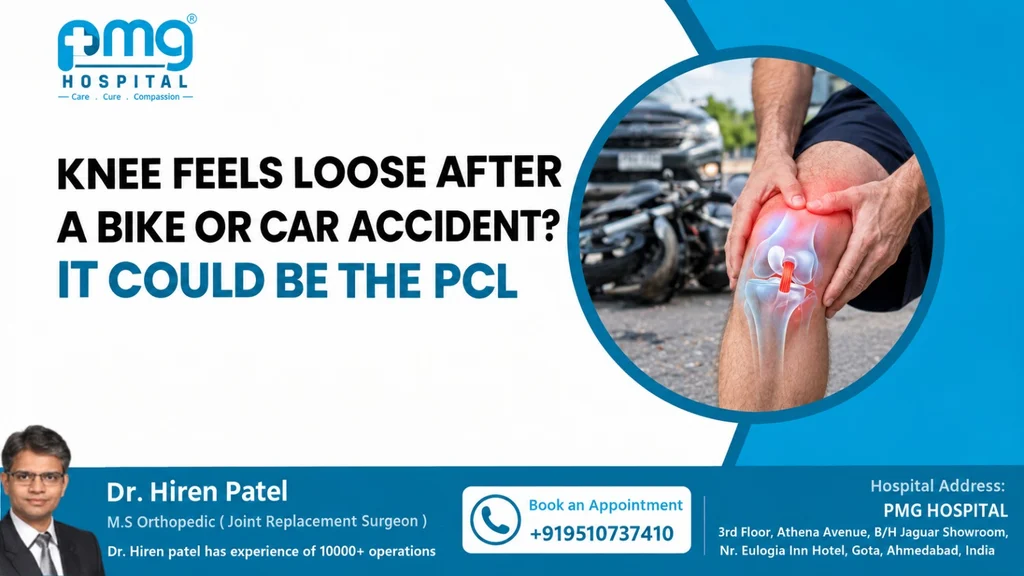
You've had a road accident. The scrapes have healed, the bruise has faded, and life is back to normal. But your knee still feels a little loose, as if it might give way on the stairs or on a slope.
That wobbly feeling is easy to ignore, and many people do. But after a hit to the front of the knee, it can be a sign of an injury to the PCL, one of the main ligaments that keeps the knee steady.
In this article, you'll learn what the PCL is, why accidents injure it, which signs to watch for, how doctors treat it, and when to get help.
What Is the PCL, and Why Does It Matter?
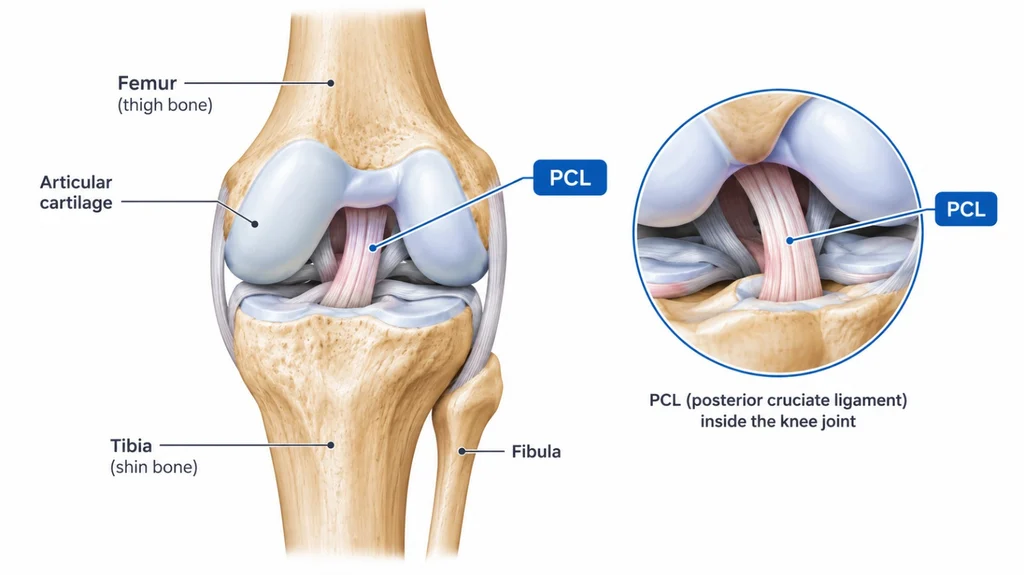
PCL stands for posterior cruciate ligament. It's a strong band of tissue inside the knee, running behind the kneecap from the thigh bone to the shin bone. Its job is to stop the shin bone from sliding backwards. It's also the strongest ligament in the knee, so it takes a serious blow to injure it.
When the PCL is stretched or torn, the knee loses part of that support. That’s why people describe the knee as loose, wobbly or "not trusting me".
Why Bike and Car Accidents Often Injure the PCL
The PCL is usually hurt when the front of a bent knee takes a hard hit, which pushes the shin bone backwards. Typical situations include:
- The knee hitting a car dashboard during sudden braking or a collision
- A two-wheeler skid or fall where you land on a bent knee
- The front of the shin striking the handlebar, road or a hard object
- A fall onto the knee with the foot pointing down
Two-wheeler riders are especially at risk, because a fall often sends the knee straight into the road or the bike frame. Helmets and seat belts protect other parts of the body, but the knee is often left exposed, so any knee trouble after a crash deserves attention.
Road accidents rarely injure just one structure, so a PCL injury can come with damage to other ligaments or the meniscus. This is one reason a proper check-up matters.
Signs Your Loose Knee May Be a PCL Injury
PCL injuries can be sneaky. Many people don't feel or hear a pop, and mild tears may cause very little pain. Here's what to look out for.
| What you notice | What it can mean |
|---|---|
| Knee feels loose or gives way | The ligament may no longer be holding the joint steady |
| Pain or tenderness at the back of the knee | Common with PCL stress, and worse when kneeling |
| Swelling around the knee | Bleeding or fluid inside the joint after injury |
| Trouble on stairs or slopes | The shin bone may be shifting backwards under load |
| Stiffness or difficulty walking normally | Pain, swelling or an unstable joint |
| Front-of-knee pain weeks later | The knee may be compensating for the missing support |
None of these signs proves a PCL tear. Only an examination and a scan can confirm it.
Don't Ignore It Just Because You Can Walk
This is where many patients go wrong. A mild PCL injury may still let you walk, so you wait. But a loose knee puts extra stress on the joint, and over the years this can raise the chance of arthritis. Advanced arthritis may eventually lead to knee replacement surgery in Ahmedabad or elsewhere, so catching the problem early is far better.
Early assessment doesn't mean you need surgery. It simply tells you what's going on so you can protect the knee properly.
How Doctors Diagnose a PCL Injury
A doctor usually starts by asking how the injury happened, then examines both knees. They check for swelling, tenderness and movement, and gently push the shin backwards to see whether it moves more than it should. Scans fill in the picture:
- MRI: the main scan for showing the ligament and other soft tissue damage
- X-ray: useful for spotting a broken bone or a small bone fragment
- Arthroscopy: a keyhole look inside the knee, used in selected cases
If a keyhole check or repair is needed, you'll want an experienced team for arthroscopy surgery in Ahmedabad.
PCL Injury Grades and Treatment Options
Doctors usually grade PCL injuries from one to three, and the grade guides the treatment.
| Grade | What's happening | Usual approach |
|---|---|---|
| Grade 1 | Mild stretch or tiny tears, knee mostly stable | Rest, ice, support and physiotherapy |
| Grade 2 | Partial tear, some looseness | Brace or splint, physiotherapy, regular review |
| Grade 3 | Complete tear, often with other ligaments injured | Surgery is often considered, especially with multiple injuries |
Most PCL injuries are treated without surgery, and many people recover well with a brace and a structured rehab plan. Surgery is usually advised when the injury is severe, when several ligaments are damaged, or when the knee stays unstable despite proper rehab.
When surgery is needed, the torn ligament is rebuilt with a tendon graft, most often through keyhole surgery. PMG Hospital in Gota offers PCL reconstruction surgery in Ahmedabad, and the team will first tell you honestly whether you need an operation at all.
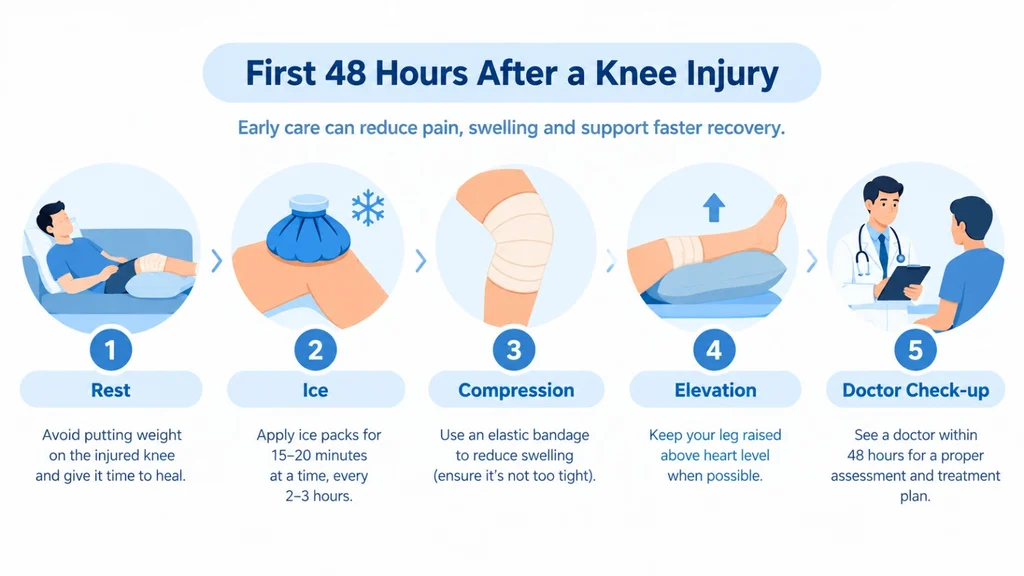
What to Do in the First 48 Hours
You don't need to diagnose yourself. You just need to protect the knee until a doctor sees it.
- Rest the leg and avoid twisting or forceful movements
- Apply ice wrapped in a cloth for short periods
- Use a light compression bandage and raise the leg when sitting
- Use crutches or support if putting weight on the leg hurts
- Avoid heavy massage or "adjustments" by untrained people
- Book an orthopaedic check-up within the first few days
If the knee looks out of shape, or your foot feels numb or cold, skip home care and go straight to an emergency department.
When to See a Doctor
Not every knee injury needs the same speed. Use this as a rough guide.
| Situation | What to do |
|---|---|
| Visible deformity, severe pain, or a numb, pale or cold foot | Go to an emergency department straight away |
| You can't put weight on the leg | See an orthopaedic doctor within 24 hours |
| Swelling, a loose feeling or trouble on stairs | Book a consultation within a few days |
| Mild symptoms that continue for weeks | Get checked, since subtle PCL injuries are easy to miss |
If you're looking for the best orthopedic doctor in Ahmedabad for a knee check-up, pick someone who examines both knees, explains your scan in plain language and discusses non-surgical options first. At PMG Hospital, OPD runs Monday to Saturday, 10:00 AM to 8:00 PM, and emergency and trauma care is available 24×7.
If your knee still feels loose after an accident, you can book a consultation or WhatsApp the PMG Hospital team on +91 96627 70141.
What Recovery Looks Like
Recovery depends on the grade and on whether other structures were hurt. Mild injuries may settle in a few weeks, and moderate ones can take a few months. After surgery, full strength and movement usually take around 6 to 12 months, sometimes longer.
Rehab is the part you control. Regular physiotherapy rebuilds the thigh and hip muscles that protect your knee, and PMG Hospital has a dedicated physiotherapy centre in Gota for this stage. Be patient with the process: returning to driving, work or sport too early can strain a healing knee, so let your doctor and physiotherapist decide when you're ready.
Frequently Asked Questions
What does a PCL injury feel like?
Most people notice a loose or unstable knee, swelling, and pain at the back of the knee that gets worse when kneeling. Some feel no pop at the time of injury, and mild tears may cause very little pain at first.
Can you walk with a torn PCL?
Often yes, especially with mild or moderate injuries. But walking doesn't mean the knee is fine. A loose knee can still be damaged and needs assessment.
Can a torn PCL heal on its own?
Mild and some moderate injuries often improve with rest, a brace and physiotherapy. A complete tear, or an injury with other ligament damage, may not recover well without surgery. Your doctor can advise after an examination and scan.
How long does a PCL injury take to heal?
Mild injuries may settle within weeks and moderate ones in a few months. After surgery, full recovery typically takes 6 to 12 months or more.
Is surgery always needed for a PCL tear?
No. Most PCL injuries are treated without surgery. Surgery is usually considered for severe tears, injuries involving several ligaments, or a knee that stays unstable after rehab.
Conclusion
A knee that feels loose after a road accident deserves attention, even if the pain has faded. The PCL is a strong ligament, and when it's injured the signs can be quiet: a wobbly feeling, swelling, trouble on stairs. The good news is that many PCL injuries heal without surgery when found early and rehabilitated well, and surgery is available when the injury is severe.
Don't wait for the knee to settle on its own. If your knee doesn't feel right after an accident, get it examined, and the team at PMG Hospital is here to help you protect your knee and get back on your feet.