
You hurt your knee in an accident or a bad fall years ago. The fracture healed, the cast came off and you went back to normal life. Then, slowly, the knee started to ache again, especially on stairs or after a long day.
This is more common than most people realise. A knee that recovers well from an injury can still wear out sooner than the other one.
In this article, we'll explain why that happens, what research shows, and what you can do to protect your knee.
What Is Arthritis After a Knee Injury?
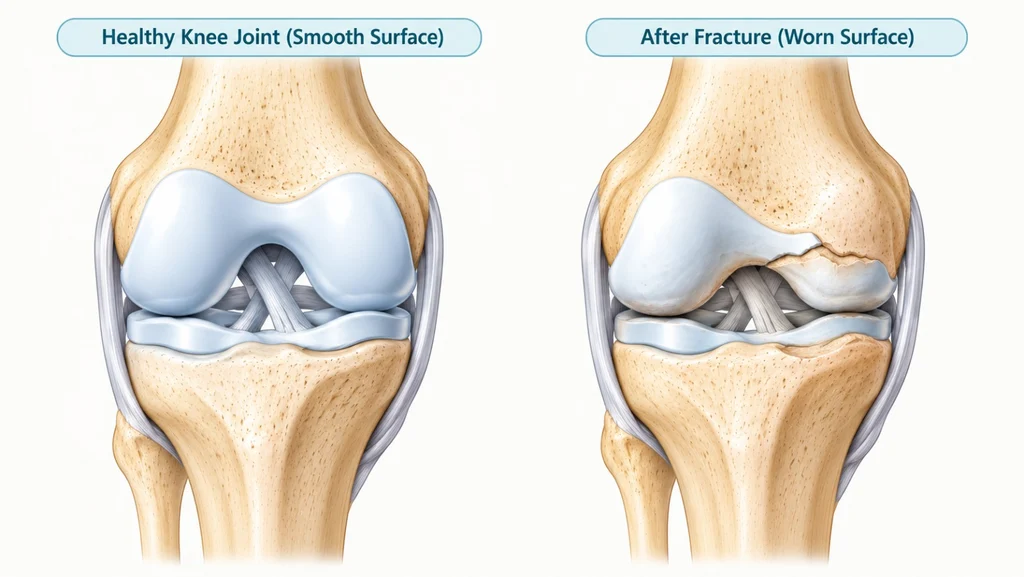
Arthritis after an injury is called post-traumatic arthritis. It's the same wear-and-tear arthritis that people get with age, but it starts earlier because an injury has damaged the joint. Inside a healthy knee, the bone ends are covered with smooth cartilage that lets them glide. When that cartilage is damaged or the joint no longer lines up properly, it wears faster, and pain and stiffness follow.
It can affect anyone, from young adults to older people. Your age at the time of injury, how severe the injury was, how well it was treated and your body weight all play a part. That's why two people with the same fracture can have very different knees ten years later.
Our page on knee trauma surgery in Ahmedabad explains how these injuries are assessed and treated in the first place.
Why Do Injured Knees Wear Out Years Later?
There isn't one single reason. Several things can go wrong, and often they happen together:
- The cartilage was damaged at the moment of injury, and cartilage has little ability to repair itself
- A fracture left a step or gap in the joint surface, so the bones no longer glide smoothly
- The leg healed slightly out of line, which changes how the knee carries weight
- A torn ligament or meniscus left the knee loose or unevenly loaded
Different injuries carry different risks, as the table below shows.
| Type of injury | Why it can lead to arthritis |
|---|---|
| Tibial plateau fracture (upper shin bone) | The fracture runs into the joint surface, so any step or gap can increase wear |
| Distal femur fracture (lower thigh bone) | A fracture near the joint can alter alignment and joint loading |
| Kneecap fracture | The joint surface behind the kneecap may be damaged or uneven |
| Fracture with ligament or meniscus injury | The knee is both damaged and less stable |
| Knee dislocation | A severe injury to the joint and its supporting structures |
What Does the Research Say?
A large Swedish study followed nearly 150,000 people aged 25 to 34 for up to 19 years. About 5,000 of them had a knee injury, and it was published in the British Journal of Sports Medicine in 2019. People with an injury were about five to six times more likely to be diagnosed with knee arthritis in the first 11 years, and the risk stayed higher, at roughly 2.7 times, for the next 8 years.
By 19 years, an extra 8.1% of injured people had been diagnosed with knee arthritis. The extra risk was highest after these injuries.
| Injury | Extra risk of knee arthritis after 19 years |
|---|---|
| Cruciate ligament injury (ACL or PCL) | About 19.6% |
| Meniscal tear | About 10.5% |
| Tibial plateau or kneecap fracture | About 6.6% |
Remember that these are population figures from young adults in one country, so they don't predict what will happen to you. Still, the message is clear: a knee injury is a lasting risk factor, and the risk starts years before you feel anything.
If you've had a torn ligament, you may find our articles on ACL tear and meniscus injury and knee instability after ACL tear useful.
Can You Lower the Risk?
Not always completely, but a lot of it depends on how the injury is treated. When a fracture runs into the joint, accurate treatment reduces the risk of arthritis, although it can't always remove it.
Here's what helps:
- Getting a proper assessment soon after the injury, including X-rays and, for most joint-surface fractures, a CT scan
- Realigning a displaced fracture as accurately as possible and fixing it firmly, so the knee can start moving early
- Treating a torn meniscus at the same time when possible, and planning ligament repair together or later
- Doing your physiotherapy, since early protected movement helps prevent stiffness
- Keeping a healthy body weight, because extra weight adds load to every step
Follow-up visits and X-rays during healing let the surgeon check that the fracture is healing in a good position. For many joint-surface fractures, weight on the leg is limited for the first 6 to 12 weeks, until X-rays show healing. Following those limits matters, because loading the knee too early can disturb the repair.
After a high-energy injury, the surgeon may fix the fracture in two stages, using a temporary external fixator first and plates and screws once the swelling has settled. For a closer look at meniscus and cartilage options, see our pages on meniscus repair surgery in Ahmedabad and cartilage restoration surgery in Ahmedabad.
Early Signs That Your Old Injury Is Catching Up
Arthritis usually creeps in slowly. Watch for:
- Pain that returns after walking, stairs or standing for long
- Stiffness after rest, especially in the morning or after sitting
- Swelling that comes and goes
- A knee that feels less steady or gives way
- Reduced bending or straightening compared with the other knee
None of these signs proves arthritis on its own. X-rays can show narrowing of the joint space or changes in the bone, and an examination helps the doctor see whether another problem, such as a meniscus tear or a loose knee, is adding to your symptoms. If your knee feels stiff after sitting, our article on why your knee feels stiff after rest explains the common causes. Don't assume it's just age, particularly if you're under 50 and had a knee injury.
What Treatment Is Available?
Treatment depends on how advanced the arthritis is and how much it affects your daily life.
| Stage | What it feels like | What doctors may suggest |
|---|---|---|
| Early | Occasional pain, mild stiffness | Exercise, physiotherapy, weight management, pain relief |
| Moderate | Regular pain, swelling, reduced movement | Structured physiotherapy, medicines, injections, and checking for treatable damage |
| Advanced | Constant pain, deformity, trouble walking | Knee replacement, once other treatment hasn't helped |
When arthritis becomes severe, knee replacement can restore comfortable movement. If only one area of the joint is worn, partial knee replacement surgery in Ahmedabad may be possible, while wider damage usually calls for total knee replacement surgery in Ahmedabad. You can read about the overall options under knee replacement surgery in Ahmedabad.
Replacement is usually kept for when other treatments have failed, and a good surgeon will think carefully about timing, especially in younger patients. If your knee has never felt right since an injury, you can book a consultation to find out where you stand.
Frequently Asked Questions
Can a knee injury cause arthritis years later?
Yes. Injuries that damage the cartilage or the joint surface, or leave the knee unstable, can lead to arthritis that appears years or even decades later. That's why a knee that bothers you long after an injury deserves a proper check.
Will I get arthritis after a knee fracture?
There is a risk after fractures that involve the knee joint, because cartilage can be damaged at the time of injury and any unevenness in the joint surface can increase wear. Accurate treatment reduces the risk but can't always remove it.
How long after a knee injury does arthritis start?
It varies. In the Swedish study, the risk was highest in the first 11 years after injury and stayed raised for at least eight more. Many people notice symptoms only much later.
Can arthritis after a knee injury be prevented?
It can't always be prevented, but you can lower the risk with accurate fracture treatment, repair of meniscus or ligament damage when needed, good rehabilitation and a healthy weight.
When is knee replacement needed for arthritis after an injury?
Knee replacement is usually considered when pain, stiffness and difficulty walking continue despite other treatment. A joint specialist can examine your knee and X-rays to say whether it's the right time.
Conclusion
Knee trauma and arthritis are closely linked. A fracture that enters the joint, a damaged cartilage surface, poor alignment or a torn ligament can all make a knee wear out years after it seemed to heal. Research shows the risk rises for years, and it's highest after ligament, meniscus and joint-surface injuries.
The good news is that careful treatment lowers the risk, and good options exist if arthritis does develop. If an old injury is giving you trouble, the team at PMG Hospital can examine your knee, explain what's happening in plain words and help you plan the next step.