
"I’m only 52, is it too early?" or "My mother is 82, is it too late?" Doctors hear these questions every week from people with painful hips, knees and shoulders.
Many families delay a decision for years because they believe there is a magic age. The reality is simpler, and a little more reassuring.
This article explains how age really affects joint replacement, what research shows for younger and older patients, and how doctors decide.
So, Is There an Age Limit?
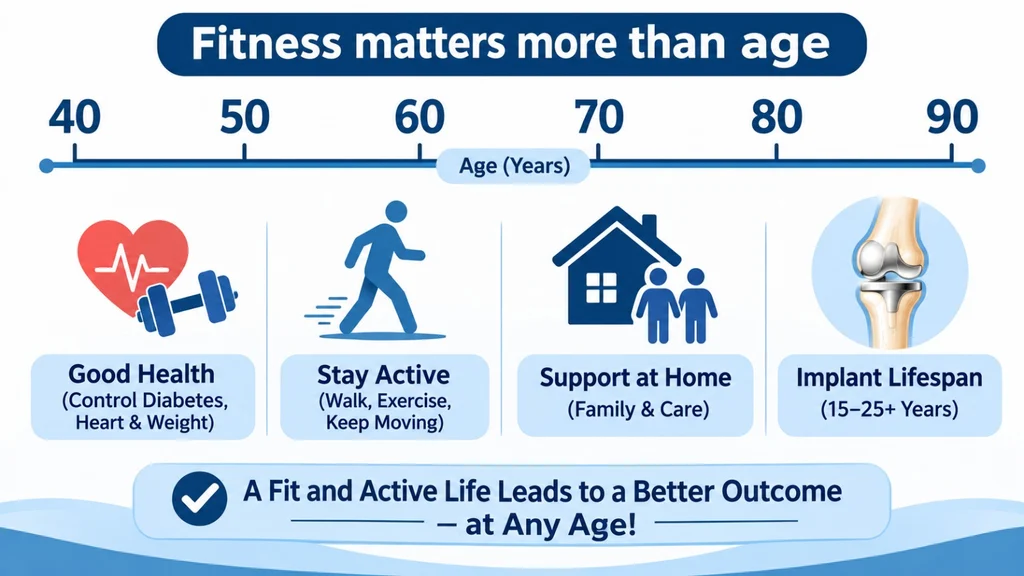
There is no fixed age limit for joint replacement. Fitness for surgery matters more than the number on your birth certificate. A healthy 80-year-old may be a better candidate than a 60-year-old with serious heart or lung problems.
Age still has a role, though. Younger patients may need another operation later, because the implant has to last for more years. Older patients may face more risks from anaesthesia and slower recovery. So age shapes the conversation, but it doesn't close the door.
What Is Joint Replacement?
Joint replacement, also called arthroplasty, is surgery that replaces a damaged joint, or its worn part, with artificial implants. Healthy joints have smooth cartilage that lets bones glide. When the cartilage wears away, bones rub together, causing pain, stiffness and limited movement.
The knee, hip and shoulder are replaced most often. The aim is pain relief and better daily function. You can read more on our page for a joint replacement hospital in Ahmedabad.
Why Age Alone Doesn't Decide
Your surgeon looks at the whole picture. These are the main points:
- Overall health: heart, lungs, kidneys, blood sugar and blood pressure
- Severity of the problem: pain that disturbs sleep or occurs at rest, trouble walking or climbing stairs, and stiffness that limits daily life
- What has been tried: weight management, exercise, physiotherapy, pain relief, walking aids and injections
- Bone quality, weight and activity level, which affect how long an implant lasts
- Support at home for the first weeks of recovery
Notice that age is only one part of a longer list.
Joint Replacement at a Younger Age
Younger patients usually need surgery for a reason other than ordinary wear. Common causes include inflammatory arthritis such as rheumatoid arthritis, loss of blood supply to the bone (avascular necrosis), and arthritis after an old injury. Our article on hip replacement in AVN explains one such case.
The main concern is longevity. A large UK study of 63,158 people published in The Lancet followed hip and knee replacements for up to 20 years. It estimated a lifetime revision risk of about 5% for patients over 70, but up to 35% for men in their early 50s. Women in the same age group had a lower risk. The authors suggested that the trend towards replacing joints in younger people should be reviewed, with patients involved in shared decisions.
This doesn't mean you should never have surgery under 60. It means timing and technique need careful thought. Surgeons usually try other treatments first, and if only one part of the knee is worn, a partial knee replacement may suit selected patients. Our guide on total versus partial knee replacement explains the choice, and body weight and joint replacement shows how weight affects implants.
Joint Replacement in Older Age
Older patients can do well, but they need careful selection. Two large studies show the picture.
| Study | What it found for patients aged 80 and above |
|---|---|
| Knee replacement, US Medicare claims, about 296,000 patients aged 80+ compared with about 1.4 million aged 65 to 79 | Medical complications were the same (1.26% in both groups). Implant-related complications were lower (1.6% vs 1.93%). Readmission within 90 days was higher (10.59% vs 9.35%), and the hospital stay was longer (3.69 vs 3.23 days) |
| Hip replacement, one hospital, 609 patients aged 80+ compared with 10,251 younger patients | Complication rates and improvement in hip scores were similar. But 90-day mortality was higher (0.329% vs 0.020%), and more older patients went to a nursing or rehabilitation facility (9.3% vs 2.6%) |
Both were retrospective studies, so they show patterns, not guarantees. The honest summary is that many people over 80 benefit, but they have more illnesses, need more help and carry a higher short-term risk. As one surgeon put it, you just have to pick the right ones.
What Matters Most at Each Stage of Life?
These are general pointers, not rules.
| Stage | What doctors think about most |
|---|---|
| Under 50 | The cause of the damage, other treatments first, and how long the implant must last |
| 50 to 65 | Balancing pain and function now against the chance of revision later |
| 65 to 80 | General fitness, other medical conditions and recovery support |
| Above 80 | A detailed fitness check, anaesthesia risk and help at home |
How Do Doctors Check If You Are Fit?
Before surgery, you will have an assessment. It includes your history and examination, X-rays, and sometimes an MRI, CT scan or ultrasound. Fitness checks include blood tests, an ECG, blood sugar and blood pressure control, and heart, lung and kidney checks as needed.
Any skin, dental or urinary infection is treated first. Your medicines, including blood thinners, are reviewed, and they change only on medical advice. Several doctors may be involved, including an orthopaedic surgeon, a physician or cardiologist, an anaesthetist and a physiotherapist. Our article on managing blood sugar before and after knee replacement shows why this preparation matters.
What If You're Told You Are Too Young or Too Old?
Don't give up. Ask what can be done to improve your chances. Treatment before surgery often includes weight management, low-impact exercise, physiotherapy, pain medicines, walking aids and sometimes joint injections.
Questions to Ask Your Surgeon
Take these questions to your consultation:
- Why is surgery advised for me now?
- Given my age, how long might the implant last, and could I need revision?
- Which implant and which type of surgery do you suggest?
- How do my health conditions change the risks?
- What help will I need at home, and for how long?
- What does long-term follow-up involve?
What About Recovery at Different Ages?
Recovery depends more on your health, strength and support than your birth year. After knee or hip replacement, most people stand and walk with support on day one, and daily activities return over about 3 to 6 months. After a shoulder replacement, a sling is worn for about four to six weeks.
Rehabilitation matters at any age, and PMG Hospital has an orthopaedic physiotherapy centre in Gota to support it. If you're considering surgery, you can book a consultation for a proper assessment of your joint and your fitness. OPD is open Monday to Saturday, 10:00 AM to 8:00 PM, with emergency care 24×7.
Frequently Asked Questions
Is there a minimum age for joint replacement?
There is no fixed minimum age. Younger patients can have surgery when damage is severe, for example after injury or avascular necrosis, but surgeons usually try other treatments first because they may need revision later.
Is there a maximum age for joint replacement?
No. Doctors look at fitness, not just age. Many patients in their 80s do well, although they carry more risk and need more support.
Can an 80-year-old have a joint replacement?
Yes, if they're fit enough after assessment. Large studies show many octogenarians benefit, but they have more illnesses and a higher short-term risk, so selection matters.
Will a younger patient need a second joint replacement?
Possibly. Younger patients have a higher chance of revision because the implant must last longer. A large UK study estimated up to a 35% lifetime risk for men in their early 50s.
Does age affect recovery after joint replacement?
It can. Older patients may stay longer in hospital and need more help, but recovery depends mainly on health, strength, rehabilitation and support at home.
Conclusion
There is no fixed age limit for joint replacement. A younger patient needs a careful look at how long the implant must last, and an older patient needs a careful look at overall fitness and support. Your health, your pain and your goals matter more than your age.
If you're wondering whether you are too young or too old, the right step is an honest assessment. The team at PMG Hospital can examine your joint, check your fitness and explain your options in plain words.