

Both your knees hurt. Climbing stairs is difficult, a short walk feels like a long one, and the thought of going through surgery twice is exhausting.
So it is natural to ask the question many patients ask their doctor: can both knees be replaced in one go?
The short answer is that it can be done, but it isn't right for everyone. This article explains the benefits, the risks, who is suitable and how to decide.
What Does Replacing Both Knees Together Mean?
There are two ways to treat arthritis in both knees:
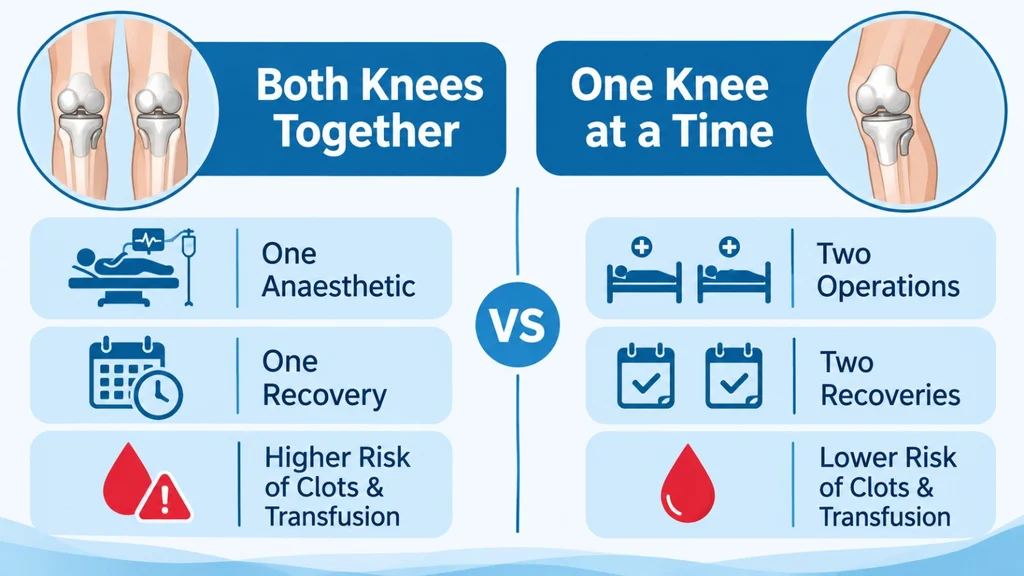
- Simultaneous (together): both knees are replaced in one operation under one anaesthetic, with one hospital stay and one rehabilitation period.
- Staged (one by one): one knee is replaced first, and the second is done weeks or months later. Surgeons often wait at least three months between the two.
In knee replacement, worn joint surfaces are replaced with metal and plastic implants. Surgery for a single knee takes about one to two hours. You can read the basics on our page about knee replacement surgery in Ahmedabad.
Why Do Patients Ask for Both Knees Together?
The reasons are practical:
- Only one anaesthetic is needed, instead of two
- One hospital stay and one recovery, so you don't go through rehab twice
- Fewer weeks away from work and family
- A possibly lower overall cost
Reports suggest it can also mean a shorter total hospital stay and lower costs. These benefits are real, but they have to be weighed against the risks.
What Does the Research Say About Safety?
Research comparing the two approaches isn't entirely one-sided. A review that pooled 18 retrospective studies found the following.
| Outcome | Simultaneous (both together) compared with staged |
|---|---|
| 30-day mortality | Higher |
| Pulmonary embolism (clot in the lung) | Higher |
| Blood transfusion | Higher |
| Deep infection | Lower |
| Revision (repeat) surgery | Lower |
| Deep vein thrombosis, cardiac complications, nerve-related complications | No significant difference |
A more recent meta-analysis reached a similar conclusion, reporting that simultaneous surgery lowers reoperation and cost at the expense of higher complications and mortality. Another source puts heart risk at about four times that of a single-knee replacement, mainly heart attacks and irregular heart rhythms. More patients also need intensive care, and confusion is more common in older adults.
Keep two things in mind. These were mostly retrospective studies, and in practice surgeons choose healthier patients for the combined operation. So the numbers show risk in selected groups, not a verdict for everyone.
Who May Be Suitable, and Who Should Think Twice?
There is no single rule, and the decision is made case by case. Still, doctors consider a few broad points.
| Situation | What it usually means |
|---|---|
| Healthy apart from knee arthritis, no heart or lung disease | May be considered for surgery together |
| Heart or lung disease, or other serious medical conditions | Staged surgery is usually safer |
| Older age | Some centres don't do it above 75, and surgeons generally advise against it above 80 |
| Poorly controlled diabetes, blood pressure or infection | Needs control first, regardless of approach |
The common thread is general health. Age matters, but heart and lung fitness matters even more.
How Do Doctors Decide?
A proper assessment comes before any decision. For knee replacement, this includes your history and examination, standing X-rays of both knees, and sometimes an MRI. It also includes fitness checks, such as blood tests, an ECG, and control of blood sugar and blood pressure, along with heart, lung and kidney checks.
Several doctors may be involved, including the orthopaedic surgeon, a physician or cardiologist, and an anaesthetist. Our article on managing blood sugar before and after knee replacement shows why this preparation matters. If you have long-standing problems, read about knee replacement for older people as well.
Is Recovery Harder With Both Knees?
Usually, yes. After one knee, you can lean on the other leg. After both, neither leg can fully support you at first, so rehabilitation is more demanding.
| Point | One knee | Both knees together |
|---|---|---|
| First steps | Often the day of surgery or the next day, with a walker | Also early, but with more support |
| Support while walking | Reduces over the first few weeks | Needed for longer, with more help |
| Help at home | Some | A lot, especially in the first weeks |
| Rehabilitation | Often at home with a physiotherapist | May need a rehabilitation facility, which is common after combined surgery |
| Overall recovery | About 3 to 6 months for strength and stamina | Slower, and it varies from person to person |
Recovery varies a lot between individuals, as our blog on why knee replacement recovery varies between patients explains. Pain control is also a bigger issue, and you can read about pain after knee replacement surgery and sleeping positions after knee replacement.
What If You Choose Staged Surgery?
Staged surgery is a safe and perfectly reasonable choice. At one leading hospital, virtually every patient who had one knee done came back for the second.
The more painful knee is often done first. This also gives you a chance to see how you recover before deciding on the second one. If only one compartment of a knee is worn and the ligaments are healthy, partial knee replacement may also be worth discussing, and our guide on total versus partial knee replacement explains the difference.
Questions to Ask Your Knee Replacement Doctor
Take this list to your consultation:
- Do both of my knees really need surgery, and should they be done together?
- What are my personal risks, given my heart, lungs, sugar and blood pressure?
- Is robotic assistance used, and why?
- What anaesthesia and pain control will I have?
- Which medicines, such as blood thinners and diabetes drugs, need to change?
- How will infection and blood clots be prevented?
- When will stairs, Indian-style toilets and sitting on the floor be safe?
- Will I need a rehabilitation facility, and how will home recovery be arranged?
Ask whether the hospital has intensive care access for high-risk patients and a proper physiotherapy set-up. PMG Hospital has an orthopaedic physiotherapy centre in Gota for this stage.
Signs That Need Quick Attention After Surgery
Whatever you choose, tell your doctor straight away if you notice:
- Chest pain or sudden breathlessness
- A swollen, painful or warm calf
- Fever, or redness and discharge from the wound
- New confusion, especially in an older person
Blood clots and infection are among the known risks of knee replacement, so early action matters.
What About Cost and Insurance?
Cost depends on whether one or both knees are operated on, the type of surgery, the implant, the technique, how long you stay, any other medical conditions and physiotherapy afterwards. Ask for an itemised estimate after assessment, and read more on the cost of knee replacement surgery page.
Medically necessary knee replacement is generally covered by insurance, subject to your policy terms and the insurer's approval. If you're unsure which route is right, you can take a second opinion or book a consultation to have your knees and your health assessed together.
Frequently Asked Questions
Is it safe to replace both knees at the same time?
It can be safe in carefully selected, otherwise healthy patients. Studies show higher risks of clots, transfusion and heart problems than staged surgery, so your doctor must check your fitness first.
What age is too old for both knees to be replaced together?
There's no single cutoff. Some centres avoid it above 75, and surgeons generally advise against it above 80, because the risk of complications rises with age and heart or lung disease.
Is recovery harder after both knees are replaced together?
Usually, yes. Neither leg can fully support you at first, so you need more help, longer support while walking and sometimes a rehabilitation facility.
How long should I wait between two knee replacements?
When surgery is staged, surgeons often wait at least three months before the second knee. Your surgeon will decide based on how you recover.
Which is better, both knees together or one at a time?
Neither is better for everyone. Combining them means one recovery, but with higher risks. Staged surgery takes longer overall, but it is gentler on your body.
Conclusion
Replacing both knees together can save you a second operation and a second recovery, but it carries higher risks of clots, transfusion and heart strain, and it is harder on your body in the first weeks. It is best suited to people who are otherwise healthy, and staged surgery is a safe, sensible alternative for everyone else.
The right answer depends on your heart, lungs, age and daily life, not on convenience alone. If you're weighing this decision, the team at PMG Hospital can assess both knees, check your fitness and explain the options in plain words.