
If your doctor has suggested a shoulder replacement, one question usually comes up quickly: how long will it last? It's a sensible thing to ask. Nobody wants to go through surgery and rehab, only to wonder whether they'll need another operation soon.
The honest answer is more reassuring than most people expect, though it comes with a few limits. Researchers have now studied thousands of shoulder replacements over many years, and their findings give us real numbers to work with.
Let's look at what those studies found, what affects your own result, and what you can do to protect your new shoulder.
What Is a Shoulder Replacement?
The shoulder is a ball-and-socket joint, held and moved by a group of tendons called the rotator cuff. In a shoulder replacement, the damaged surfaces of the ball and socket are replaced with artificial parts. It's usually considered when arthritis, a serious injury or a severe rotator cuff problem keeps causing pain and weakness despite other treatment.
There are several types, including total, reverse, partial and revision. Our page on shoulder replacement surgery in Ahmedabad explains how each one works and who it suits.
So, How Long Does a Shoulder Replacement Last?
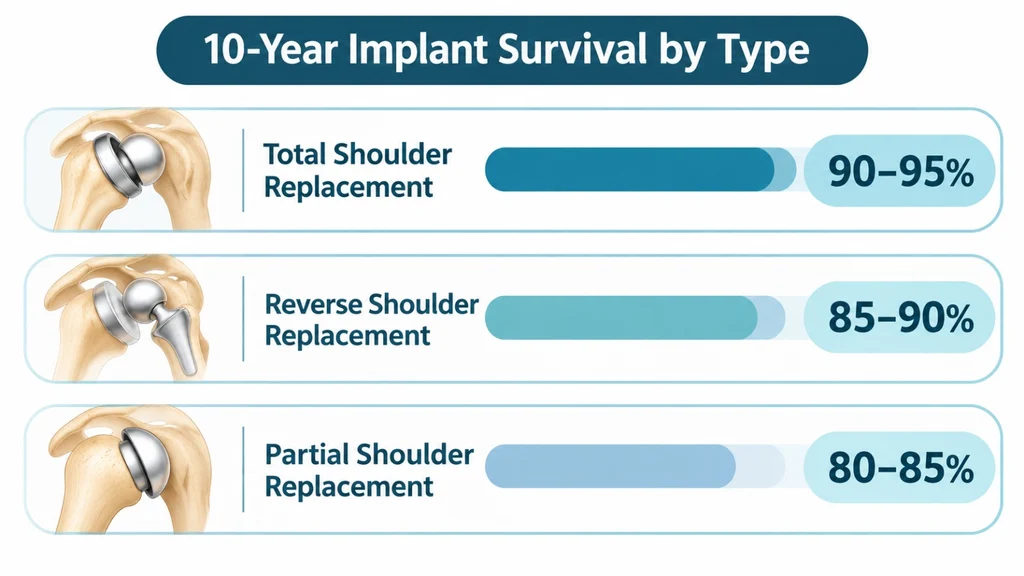
Most shoulder replacements last at least 10 years. A large review published in The Lancet Rheumatology in 2020, led by Dr. Jon Evans, pooled results from case series and a national joint registry covering nearly 18,000 patients. It concluded that about nine out of ten shoulder replacements were still working a decade after surgery.
Here, "lasting" means the implant did not need to be revised, which is a second operation to fix or replace it. The figures varied a little by type.
| Type of replacement | Usually considered when | Implants still in place at 10 years |
|---|---|---|
| Total (anatomic) | Whole-joint arthritis with a working rotator cuff | About 92 to 95% |
| Reverse total | Arthritis with a badly torn or non-working rotator cuff | About 94% |
| Partial (hemiarthroplasty) | Damage limited to the ball of the joint | About 86 to 90% |
To put that in simple terms: if 100 people had a total shoulder replacement, around 92 to 95 of them wouldn't need another operation on that shoulder within 10 years. That's the practical meaning of "10-year survival". Partial replacements had the lowest figures, though these came from pooled studies that differed from each other, so don't read too much into the gap. If you'd like to understand when each type is chosen, you can read about total shoulder replacement surgery in Ahmedabad and partial shoulder replacement surgery in Ahmedabad.
Lasting Is More Than Staying in Place
An implant that's still in the bone isn't much use if the shoulder still hurts, which is why success is judged by how you feel and move, not only by how the X-ray looks. The good news is that patients in these studies reported large improvements in pain, everyday function, strength and movement, and those gains held for up to 10 years.
The lead researcher also noted that shoulder replacements now look similar to hip and knee replacements in how long they last. Hip and knee replacement have the longer track record, so this is encouraging news for shoulder patients.
What About 15 or 20 Years?
This is where honesty matters. Studies beyond 10 years are limited, so nobody can promise you a specific number of years. Many national registries only started recording shoulder surgery recently, and most long-term data comes from specialist centres.
| What we know | What we don't know yet |
|---|---|
| Around nine in ten implants last 10 years or more | How many last 15 or 20 years |
| Pain, function and strength improve for up to 10 years | Long-term results for every patient type |
| Reverse and total implants do similarly at 10 years | Exactly why partial replacements do slightly worse |
What Affects How Long Yours Will Last?
Two people with the same implant can have different results. The main factors are:
- The type of replacement chosen for your shoulder
- The reason you needed surgery in the first place
- The condition of your rotator cuff, which is the most important factor in choosing the type
- The quality of your bone
- Your age and how active you are
Because the rotator cuff matters so much, our article on shoulder replacement for rotator cuff tears is worth reading if you have a long-standing tear. Using an anatomic replacement in a shoulder with a non-working cuff makes early loosening or instability more likely.
Age matters too. A younger, active patient asks an implant to work harder for more years. That is one reason surgeons usually try other treatments first, such as activity changes, physiotherapy, medicines and injections, before recommending replacement.
Why Shoulder Replacements Sometimes Wear Out or Fail
Most replacements don't need a second operation, but when they do, the reasons are fairly well known.
| Problem | What it means | What you might notice |
|---|---|---|
| Loosening or wear | The implant slowly stops gripping the bone, or the plastic wears | Gradual return of pain or weakness |
| Instability | The joint feels loose or slips out of position | A shoulder that feels unsteady or gives way |
| Infection | Germs reach the implant, sometimes months or years later | Increasing pain or stiffness, even without fever |
| Stiffness | Scar tissue limits movement | A shoulder that gets harder to move |
| Fracture | A bone breaks around the implant | Sudden pain after a fall or injury |
Infection deserves special mention, because it can appear months or years after surgery. A shoulder that becomes more painful or stiff for no clear reason needs checking, even if you have no fever. If you notice any of these, don't wait. A revision operation can often correct the problem, and you can read about revision shoulder replacement surgery in Ahmedabad to understand what it involves. Our blog on why joint replacements need revision surgery explains the common causes, and stiff shoulder after shoulder replacement covers one of them in detail.
How to Help Your New Shoulder Last Longer
You can't control everything, but several habits make a real difference.
- Go to your follow-up visits, since they help catch wear or loosening early
- Finish your rehabilitation, because strong muscles protect the joint
- Follow your surgeon's advice on lifting and activity
- Report new or increasing pain early instead of waiting it out
- Tell any doctor treating you that you have a shoulder implant
Rehab matters most in the first few months, and our article on shoulder replacement recovery and restrictions walks through what to expect. PMG Hospital also has an orthopaedic physiotherapy centre in Gota to support this stage.
If you've had a steroid injection in the shoulder recently, tell your surgeon before surgery, because one within about three months may raise the risk of infection. Dr. Hiren Patel leads joint replacement at PMG Hospital, and our shoulder replacement page stresses regular follow-up, since it helps detect wear or loosening early. If your shoulder replacement is several years old, or something doesn't feel right, you can book a consultation for a proper check.
Frequently Asked Questions
How long does a shoulder replacement last?
Most shoulder replacements last at least 10 years. A large review found that about nine in ten implants hadn't needed revision at the 10-year mark, though data beyond that is limited.
Do reverse shoulder replacements last as long as total shoulder replacements?
At 10 years the figures look similar, at about 94% for reverse and 92 to 95% for total replacements. The right choice depends mainly on whether your rotator cuff is working.
How do I know if my shoulder replacement is wearing out?
Watch for returning pain, new weakness, stiffness, or a shoulder that feels unsteady. Increasing pain can also be a sign of infection, so report it early rather than waiting.
Can a shoulder replacement be redone?
Yes. A revision operation can correct or replace an implant that is loose, worn, unstable or infected. It's usually more complex than the first surgery, so it needs careful assessment.
Do shoulder replacements last as long as hip or knee replacements?
The lead researcher noted that shoulder replacement results now look similar. Hip and knee replacements still have more long-term data behind them.
Conclusion
Most shoulder replacements last at least 10 years, and about nine in ten are still working at that point. Results for total and reverse replacements look similar, partial replacements do slightly less well, and we simply don't have enough data yet to promise anything beyond 10 years.
What matters most is choosing the right type of replacement for your shoulder, finishing your rehab and keeping up with check-ups. If you're weighing surgery or wondering about an older implant, the team at PMG Hospital can examine your shoulder, explain the research in plain words and help you plan with confidence.