
You've been living with joint pain for a long time. Tablets, exercises and injections gave some relief, but the pain keeps coming back. Now someone has mentioned joint replacement, and the first thing you want to know is simple: can my joint be replaced at all?
The short answer is that most people think only of knees and hips. In reality, several joints can be replaced, though not all of them are equally common or equally successful.
This article explains which joints can be replaced, how common each one is, and how doctors decide what suits you.
What Is Joint Replacement?
Joint replacement, also called arthroplasty, is an operation in which a damaged joint, or the worn part of it, is replaced with artificial parts called implants. These are usually made of metal, medical-grade plastic or ceramic. Surgeons recommend it when pain and stiffness continue despite proper non-surgical treatment.
If you'd like the full overview first, our page on joint replacement surgeon in Ahmedabad explains the process from assessment to recovery.
Which Joints Can Be Replaced?
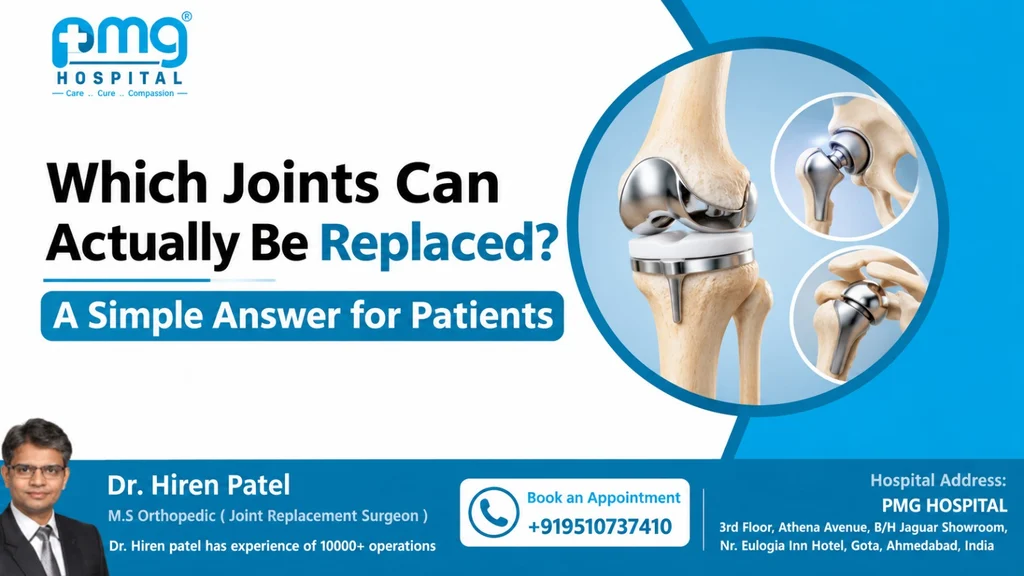
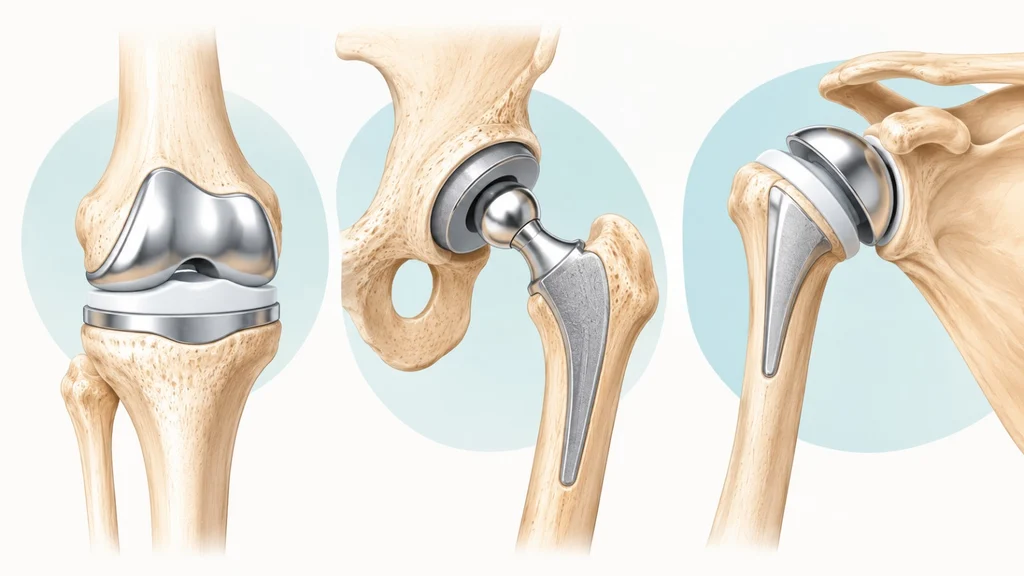
The joints most often replaced are the knee, the hip and the shoulder. Ankles, elbows, wrists and finger joints can also be replaced, but these operations are less common and are done only in selected cases.
| Joint | How common | Usual reasons for replacement |
|---|---|---|
| Knee | Very common | Osteoarthritis, rheumatoid arthritis, injury-related arthritis |
| Hip | Very common | Arthritis, avascular necrosis, some fractures |
| Shoulder | Common | Arthritis, rotator cuff tear arthropathy, severe injury |
| Ankle | Less common | Severe ankle arthritis, arthritis after injury |
| Elbow | Uncommon | Severe arthritis, injury, degenerative conditions |
| Wrist | Uncommon | Advanced wrist arthritis, injury |
| Fingers and thumb | Uncommon | Severe arthritis in the knuckle or thumb-base joints |
Spinal discs can also be replaced in some cases, but that's a separate specialty. Let's look at each of the main joints in more detail.
Knee Replacement
The knee is the joint most people think of first, and for good reason. It carries your body weight with every step, so cartilage wear here quickly affects walking, stairs and sleep.
Knee replacement comes in a few forms. In a total knee replacement, the damaged surfaces of the whole joint are replaced. You can read more about total knee replacement surgery in Ahmedabad. In a partial knee replacement, only the damaged section is replaced, which suits people whose damage is limited to one part of the knee. Only a small share of patients qualify for this, and our page on partial knee replacement surgery in Ahmedabad explains who they are.
For a complete overview of options, see knee replacement surgery in Ahmedabad. At PMG Hospital, knee replacement can also be done with robotic assistance using the ROSA Knee System, when it suits the individual knee. Robotic assistance is used for knee replacement only.
Hip Replacement
The hip is a ball-and-socket joint, and replacement is often considered when arthritis, avascular necrosis (loss of blood supply to the hip bone) or a fracture damages it badly. Hip pain often shows up in the groin or thigh, so people don't always connect it to the joint.
Hip replacement can be total, where both the ball and socket are replaced, or partial, where usually only the ball is replaced. Details are on our hip replacement surgery in Ahmedabad page, and you can read about total hip replacement surgery in Ahmedabad separately.
Shoulder Replacement
Many people are surprised to learn that the shoulder can be replaced too. It's considered for severe arthritis, a long-standing rotator cuff tear that has damaged the joint, or a serious injury.
There are two main designs. In a standard shoulder replacement, the ball and socket are replaced in their natural positions. In a reverse shoulder replacement, their positions are swapped, which helps when the rotator cuff no longer works properly. You can read about shoulder replacement surgery in Ahmedabad to see which suits which patient. After surgery, a sling is usually worn for about four to six weeks, and strength and movement can keep improving for up to a year.
Ankle, Elbow, Wrist and Finger Joints
These joints can be replaced, but they have a shorter track record than hips and knees. Ankle replacement is becoming more common as implants improve. Elbow replacement usually comes with lifting limits afterwards, often around 5 to 10 pounds. Wrist and finger replacements are done for advanced arthritis, typically after other treatments have not worked.
For some of these joints, doctors may suggest fusion instead, where the bones are joined so the joint no longer moves. It relieves pain but doesn't improve movement. For toes, fusion is often the usual choice. Because results vary more for these joints, it's worth asking any surgeon how often they perform the operation.
PMG Hospital's joint replacement work covers the knee, hip and shoulder, including revision surgery. If your problem is in another joint, your doctor will tell you honestly whether you need a specialist for it.
Total, Partial and Revision: Types of Replacement
Whichever joint is involved, the surgery usually falls into one of these types.
| Type | What it means | Usually considered when |
|---|---|---|
| Total replacement | The whole joint surface is replaced | Damage is widespread |
| Partial replacement | Only the worn part is replaced | Damage is limited and the rest of the joint is healthy |
| Reverse shoulder replacement | Ball and socket are swapped | The rotator cuff is badly damaged |
| Revision replacement | An earlier implant is repaired or replaced | The implant has worn, loosened or developed a problem |
If you've already had a joint replaced and something doesn't feel right, revision knee replacement surgery in Ahmedabad explains what a second operation involves.
How Do Doctors Decide Which Joint Replacement You Need?
There's no single rule, because every joint and every patient is different. Doctors usually look at:
- How badly the joint is damaged on X-rays and other scans
- How much pain, stiffness and difficulty you have in daily life
- Whether medicines, physiotherapy, weight management and injections have already been tried
- Your age, general health and activity level
- Your goals, such as walking pain-free, climbing stairs or returning to work
Surgery is usually considered only after other treatments have failed to give enough relief. That's why a good doctor will first review what you've already tried, such as medicines, exercise, physiotherapy and injections. Tell the surgeon about any recent steroid injection in the joint, because it can raise the risk of infection if surgery follows too soon. If you want help judging whether it's time, read our article on warning signs you need joint replacement surgery.
When Should You Get Your Joint Checked?
You don't need to wait until the pain is unbearable. Consider an assessment if you notice any of these.
- Joint pain that wakes you at night or limits walking
- Stiffness that doesn't ease with rest, medicines or exercise
- A joint that looks out of shape, swollen or feels unstable
- Difficulty with daily tasks such as climbing stairs, dressing or lifting a cup
Not everyone who has joint pain needs surgery, and a good consultation will cover non-surgical options first. Bring your old X-rays and a list of your medicines to the visit, since they help the doctor give a clearer answer. At PMG Hospital, OPD runs Monday to Saturday, 10:00 AM to 8:00 PM, and Dr. Hiren Patel leads joint replacement. If you're unsure about your joint, you can book a consultation and get a clear answer.
Frequently Asked Questions
Which joints can be replaced?
The knee, hip and shoulder are the most commonly replaced joints. Ankle, elbow, wrist and finger joints can also be replaced in selected cases, though these operations are less common.
Which joint is replaced most often?
Knees and hips are replaced more than any other joints. Shoulder replacement comes next and is becoming more widely used.
Can an ankle, elbow or wrist be replaced?
Yes, in selected patients with severe arthritis or injury. These joints have a shorter track record than hips and knees, and fusion is sometimes recommended instead.
Is there an age limit for joint replacement?
There's no fixed age limit. Doctors look at your joint damage, general health and fitness for surgery rather than age alone.
How long does a joint replacement last?
Large studies show that most total knee and hip replacements are still working 15 to 20 years after surgery. How long yours lasts depends on your weight, activity level and rehabilitation.
Conclusion
So, which joints can be replaced? Knees, hips and shoulders are the most common, and ankles, elbows, wrists and finger joints can be replaced in selected cases. The right answer for you depends on which joint is damaged, how badly, and whether other treatments have been tried.
If joint pain is slowly taking away things you enjoy, an honest assessment is the best first step. The team at PMG Hospital is ready to look at your joint, explain your options in plain words and help you decide at your own pace.