Your shoulder has hurt at the front for months. Physiotherapy and tablets helped a little, but the pain keeps coming back, and now a doctor has used two words you have never heard before: biceps tenodesis.
Before you say yes, it helps to know what to ask. A good surgeon expects questions and answers them in plain words.
This guide lists the questions that matter, explains why each one is important and tells you what a clear answer should sound like.
What Is Biceps Tenodesis?
The biceps muscle has two tendons at its upper end. The long head starts at the upper rim of the shoulder socket, crosses the ball of the joint and leaves through a groove in the arm bone. Because of this long route, it is easily irritated.
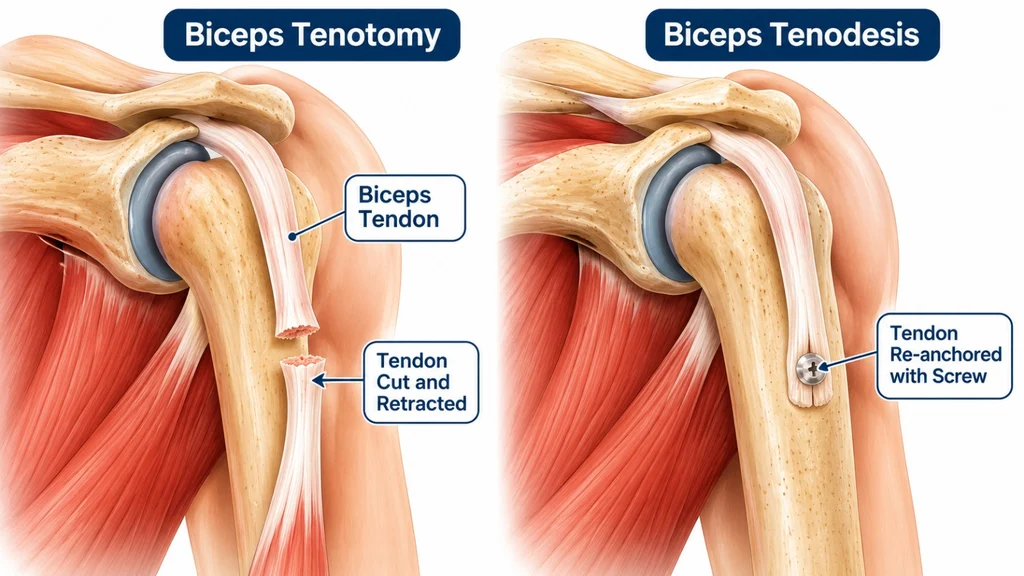
In biceps tenodesis, the surgeon releases the tendon inside the joint and fixes it lower down on the arm bone, outside the joint. The painful part is removed, while the muscle keeps working. Elbow bending and forearm rotation usually stay strong. You can read more on our page for a biceps tenodesis surgeon in Ahmedabad.
Why Do the Right Questions Matter So Much?
Pain at the front of the shoulder does not always come from the biceps. The rotator cuff, the labrum or the joint itself can cause very similar pain. Surgery helps only when the biceps is truly the source, so the first job is to confirm that.
Question 1: How Sure Are You That the Biceps Is the Problem?
This is the most important question. Your surgeon should be able to point to the evidence, which usually comes from three places.
| How the source of pain is checked | What it tells you |
|---|---|
| Examination | Tenderness over the biceps groove, and specific tests that separate biceps pain from cuff or joint pain |
| Ultrasound or MRI | The condition of the tendon, plus any related rotator cuff or labral tears |
| Injection near the tendon | If pain eases, it may help confirm the tendon as the source |
Also ask whether another problem is present. A cuff tear or a labral tear may need treatment in the same operation, and it changes the plan completely.
Question 2: Do I Need Surgery Right Now?
Surgery is usually considered only after pain fails to settle with physiotherapy, changes in activity and sometimes an injection. Surgery is usually suggested in situations like these:
- Long-standing inflammation of the long head tendon that doesn't settle
- A partly torn or frayed tendon
- A tendon that slips out of its groove
- A SLAP tear, where the tendon's anchor has pulled off the socket rim
- A rotator cuff tear that needs repair, where the biceps is also causing pain
If your scan shows one of the last two, read about SLAP tear repair and rotator cuff repair, because biceps tenodesis is often done alongside them. If the pain sits on the top of the shoulder instead, ask whether shoulder bursitis could be involved.
Question 3: Tenodesis or Tenotomy, and Why?
Many patients don't realise there are two options. In tenotomy, the tendon is cut and allowed to retract. In tenodesis, it is re-anchored to the bone. A good surgeon will explain why one suits you better.
| Point | Tenotomy | Tenodesis |
|---|---|---|
| What happens | The tendon is cut and left to retract | The tendon is fixed to the arm bone |
| Operation | Quicker | Slightly longer |
| Upper-arm bulge (Popeye sign) | More likely | Less likely |
| Cramping and loss of forearm rotation strength | Possible, usually small | Aimed at avoiding it |
| Recovery | Simpler | A protected period is needed |
| Often preferred for | Older or less active patients | Younger, active or slimmer patients |
Research points the same way. A 2022 review in International Orthopaedics pooled nine randomised trials with 572 patients. It found fewer Popeye deformities after tenodesis, while tenotomy gave slightly better pain relief at three months, with no clear pain difference later. Differences in strength were small, and the review's own further analysis called them inconclusive.
Question 4: What Exactly Will Happen During the Operation?
Ask the surgeon to walk you through it, step by step. The operation is done under general anaesthesia, often with a nerve block for pain. The surgeon looks inside the shoulder with a camera, checks the tendon along its length, releases it from the socket rim and fixes it to the arm bone with a screw, an anchor or a button.
Good questions to ask here:
- Which fixation method will you use, and why?
- Will it be done through a keyhole or through a small cut at the front of the arm?
- Will other findings, such as bursa inflammation, bone spurs or labral and cuff tears, be treated in the same session?
Many patients go home the same day. Learn more about arthroscopy for shoulder problems if you'd like to understand the keyhole approach.
Question 5: What Will Recovery Look Like?
Recovery is where patients feel the surgery most, so ask for a clear timeline. Here is what to expect, in broad terms.
| Time after surgery | What usually happens |
|---|---|
| First 2 to 4 weeks | You wear a sling, with early gentle shoulder and elbow movement |
| Up to 6 weeks | Resisted elbow bending and lifting are avoided |
| 6 to 8 weeks | Strengthening begins |
| First few weeks | Front-of-shoulder pain usually settles |
| 2 to 3 months | Daily activities are resumed |
| 4 to 6 months | Lifting and sport strength return |
If a rotator cuff repair is done in the same operation, recovery takes longer. Also ask about sleeping and bathing with the sling, when you can drive, and when you can return to work.
Question 6: What Are the Risks for Me?
Every operation carries risks, and your surgeon should go through them with you instead of skipping them. They include:
- Infection of the wound or joint, which is uncommon
- Shoulder stiffness
- Rare injury to a nerve or blood vessel
- Numb skin around the cuts
- Persistent pain, or tenderness at the fixation site
- A loosened fixation, which can cause an upper-arm bulge
- Rare blood clots, a rare fracture at the fixation site, and anaesthesia risks
Ask which of these matters most in your case. For example, if you have diabetes or a heart or lung condition, a physician may need to check your fitness first.
Question 7: Who Is Your Surgeon, and What Does the Hospital Offer?
Choosing the surgeon matters as much as choosing the procedure. Look for these points, and don't hesitate to ask:
- A valid medical council registration and clear qualifications
- Regular experience with this operation
- Infection-prevention practices
- The implants and tests that will be used
- Physiotherapy and follow-up after surgery
- An itemised written estimate
Be careful with phrases like "modern facilities", and ask which facilities are actually available. You can see the qualifications, fellowship training and registration number of Dr. Hiren Patel on the about page.
What About the Cost and Insurance?
Cost depends on several things: tenodesis or tenotomy, the fixation device, any other procedures done at the same time, a day-care or overnight stay, the room category, scans and physiotherapy afterwards. Ask for the estimate in writing, itemised.
Medically necessary biceps surgery is generally covered by insurance, but it depends on your policy terms, waiting periods and the insurer's approval.
Ready to Talk to a Surgeon?
If front-of-shoulder pain keeps coming back, you can book a consultation and bring your scans, your questions and a family member if you like. OPD is open Monday to Saturday, 10:00 AM to 8:00 PM, and Sunday by appointment, at Gota, Ahmedabad. You can also WhatsApp +91 96627 70141.
Frequently Asked Questions
Will I lose biceps strength after biceps tenodesis?
Usually not in a way you notice, because the tendon stays attached to bone. Elbow bending and forearm rotation generally stay strong.
What is the Popeye sign after biceps surgery?
It is a bulge in the upper arm caused by a retracted tendon, most often after tenotomy. It is usually painless and mainly a cosmetic concern.
Can biceps tenodesis be done on its own?
Sometimes, but it is often combined with rotator cuff, labral, bursa or bone spur treatment in the same session.
When can I lift after biceps tenodesis?
Resisted lifting and elbow bending are avoided for about 6 weeks. Heavier lifting and sport usually return at around 4 to 6 months, and later if a cuff repair was done too.
Is biceps tenodesis covered by insurance?
Medically necessary surgery is generally covered, subject to your policy terms, waiting periods and insurer approval. Ask about cashless treatment and the documents needed.
Conclusion
Biceps tenodesis is a well-planned operation that can end long-standing front-of-shoulder pain while keeping your biceps working. But it is only right when the biceps is truly the cause, other treatment hasn't worked, and you understand the choice between tenodesis and tenotomy, the recovery and the risks.
If you'd like a careful assessment and a plain-language plan for your shoulder, you can meet Dr. Hiren Patel.