
The doctor has advised a knee replacement. You've understood the surgery, but the next question is often about money: will insurance pay, and will the hospital accept cashless treatment?
Many families discover the answers late, sometimes at the admission counter. A little preparation saves a lot of stress, and it can avoid a rejected claim.
This guide explains how insurance and cashless treatment usually work for knee replacement, what to check in your policy and what to ask a hospital.
What Is Knee Replacement?
Knee replacement is surgery that replaces worn knee surfaces with metal and medical-grade plastic parts. It is mainly advised for advanced arthritis that no longer responds to medicines, exercise and physiotherapy. The operation may be total, partial or revision, and it usually takes about one to two hours for one knee.
The type of surgery mainly changes the bill. You can read the basics on our page for a knee replacement hospital in Ahmedabad, and the difference between total knee replacement and partial knee replacement.
Is Knee Replacement Covered by Health Insurance?
Usually, yes. Medically necessary knee replacement is generally covered, but subject to your policy terms, waiting periods and the insurer's approval. Cosmetic or non-essential procedures are typically excluded, which is why your doctor's written advice and your scans matter.
Here is what is usually covered and what deserves a closer look.
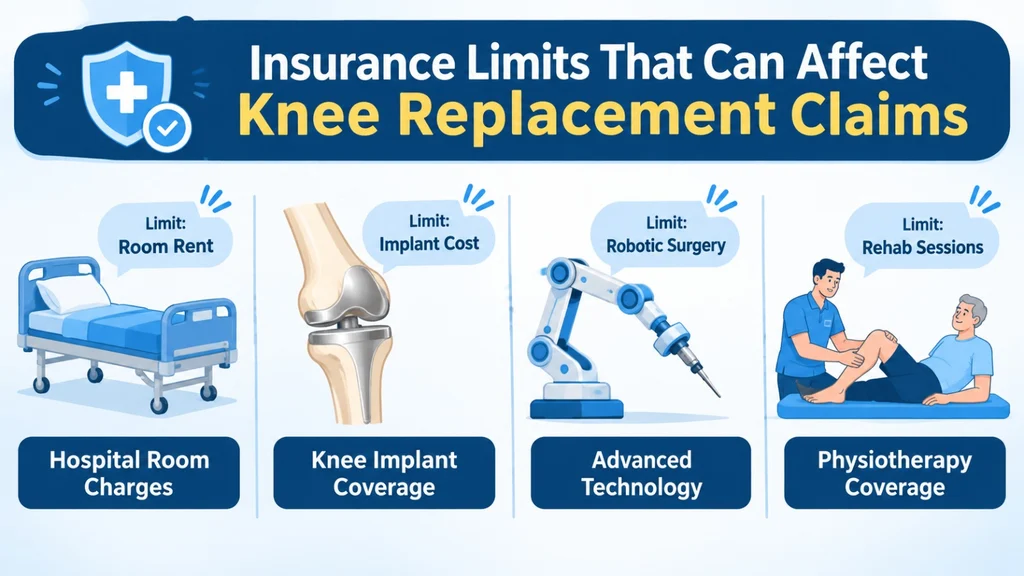
| Usually covered | Check carefully |
|---|---|
| Hospital stay and surgeon's fees | Room rent limit |
| Operation theatre and anaesthesia | Implant cost limit |
| Medicines and consumables | Robotic surgery limit |
| Tests during admission | Physiotherapy after discharge |
| Pre- and post-hospital costs, in many plans | Waiting period and exclusions |
What Is the Waiting Period for Knee Replacement?
Joint replacement usually carries a waiting period. Sources put it at about two years in most plans, and anywhere between two and four years depending on the insurer.
| Situation | What usually applies |
|---|---|
| Wear-and-tear arthritis | Standard waiting period, often about two years |
| Knee surgery after an accident | Generally not subject to this waiting period |
| Pre-existing condition declared at purchase | Waiting period is capped at three years under current IRDAI rules |
| Employer group policy | Often no waiting period, but cover may end if you leave the job |
These figures come from insurance guides, not your contract. Always read your own policy wording or ask your insurer, because plans differ.
Room Rent, Implant and Robotic Limits: The Hidden Part
Many claims are reduced not because surgery is excluded, but because of limits inside the policy.
- Room rent cap: If you choose a room costlier than your limit, other charges may be reduced in proportion, not just the room difference
- Implant cap: Advanced implants may not be fully reimbursed
- Robotic surgery limit: Some policies allow only a part of the sum insured or of the bill. One insurance guide gives an example of a ₹1.5 lakh cap on a ₹10 lakh policy
- Physiotherapy: Rehabilitation after discharge may not be fully reimbursed
So before you choose a technique or a room, check these limits. Our article on robotic knee replacement cost in Ahmedabad explains what affects the robotic bill.
What Does Cashless Treatment Mean?
In cashless treatment, the insurer pays the hospital directly, so you don't arrange the full amount in advance. You still pay for items your policy doesn't cover. In reimbursement, you pay first and claim the money later.
| Point | Cashless | Reimbursement |
|---|---|---|
| Who pays first | Insurer pays the hospital | You pay the hospital |
| Approval | Pre-authorisation before admission | Claim after discharge |
| Hospital | Usually a network hospital | Any hospital |
| Paperwork | Mostly handled by the hospital desk | You submit bills and reports |
| Stress at admission | Lower | Higher |
Whether a hospital offers cashless treatment depends on its tie-ups with your insurer or its TPA. So ask early, and don't assume.
How Does Cashless Approval Work, Step by Step?
For planned surgery like knee replacement, the process is usually like this:
- 1Your surgeon examines your knee, reviews the scans and advises surgery in writing
- 2You ask the hospital for a written, itemised estimate
- 3The hospital's insurance desk sends a pre-authorisation request to your insurer or TPA, with your reports
- 4The insurer approves, queries or rejects the request, and may ask for more documents
- 5You're admitted, and after surgery the hospital sends the final bill for approval
- 6You pay only the non-covered items and are discharged
Under IRDAI's 2024 master circular, insurers must decide on a cashless request within one hour, and give final discharge authorisation within three hours. That doesn't mean you should wait until the last day. For planned surgery, apply several days before admission so that questions can be answered calmly.
Which Documents Should You Keep Ready?
Hospitals and insurers commonly ask for:
- Your policy copy, health card and a photo ID
- The doctor's advice or prescription, and the diagnosis
- X-rays, MRI and other reports
- Blood tests and fitness reports
- A written estimate of cost
- Earlier discharge summaries and prescriptions, especially for knee or other pre-existing problems
Ask which documents your insurer needs, as requirements vary.
Why Do Claims Get Rejected or Reduced?
Most rejections have simple reasons. Watch for these:
- A pre-existing condition that wasn't disclosed when you bought the policy
- Surgery within the waiting period
- The insurer doesn't consider the surgery medically necessary
- Room rent, implant or robotic limits
- Missing or unclear documents
Disclose all past knee problems honestly when buying or renewing, because insurers check old records. If surgery is urgent, ask your insurer whether any plan or top-up allows a shorter wait.
What Should You Ask the Hospital and Your Insurer?
Ask your insurer: Is knee replacement covered? How long is my waiting period? What is my room rent limit? Are there limits on implants or robotic surgery? Does the policy cover pre- and post-hospital costs?
Ask the hospital: Is cashless treatment available for my insurer? Who handles the paperwork? What does the estimate include? What could increase the bill, for example a longer stay or another health problem? Our guide to knee surgery tips for Ahmedabad patients helps you prepare for the admission as well.
What Decides the Final Bill?
Cost depends on whether one or both knees are operated on, total, partial or revision surgery, the implant, robotic or conventional technique, the length of stay, room category, other medical conditions and physiotherapy. Our blog on the cost of knee replacement surgery explains these in detail.
Ask for a written, itemised estimate after your knee has been assessed. A fixed price promised over the phone, before any examination, should make you careful.
Plan Recovery Costs Too
Your costs don't end at discharge. Physiotherapy, follow-up visits and medicines continue for weeks, and recovery varies between people, as our blog on why knee replacement recovery varies explains. PMG Hospital has an orthopaedic physiotherapy centre in Gota, so it's worth asking how rehabilitation is planned and billed.
Diabetes control before surgery matters too, and our article on managing blood sugar before and after knee replacement explains how.
If you're comparing options or need clarity on your plan, you can book a consultation and bring your policy and reports. A second opinion is also available. OPD is open Monday to Saturday, 10:00 AM to 8:00 PM.
Frequently Asked Questions
Is knee replacement covered by health insurance?
Medically necessary knee replacement is generally covered, subject to your policy terms, waiting periods and insurer approval. Always confirm with your insurer before admission.
What is the waiting period for knee replacement insurance?
Most plans have a waiting period of about two years for joint replacement, though it can be up to four years in some. Accident-related surgery is generally not subject to it.
How long does cashless approval take?
IRDAI's 2024 master circular asks insurers to decide on a cashless request within one hour and to give final discharge authorisation within three hours. For planned surgery, apply several days early.
Does insurance cover robotic knee replacement?
It may, but some policies limit robotic or computer-assisted surgery to a share of the sum insured or the bill. Check this limit before choosing the technique.
What if the hospital doesn't offer cashless treatment for my insurer?
You can pay and claim a reimbursement afterwards. Keep all bills, reports and the discharge summary, and ask the insurer which documents it needs.
Conclusion
Medically necessary knee replacement is generally covered by health insurance, but the details decide what you actually pay: the waiting period, room rent and implant limits, and whether cashless treatment is available at your hospital. Read your policy, disclose your history, and ask for a written estimate before admission.
With a little planning, cashless approval is smooth and the focus stays on recovery. If you'd like help understanding your treatment and the paperwork, the team at PMG Hospital is happy to guide you.