

Hearing that your joint replacement is infected is frightening. You went through surgery, rehab and months of effort, and now the doctor is talking about taking the implant out and putting in something called a spacer.
It helps to know that this is a recognised, well-planned treatment, and that most infections can be cleared. Understanding each step makes the process much less scary.
This article explains how an infected joint replacement is treated, what an antibiotic spacer actually does, and what you can expect along the way.
What Is an Infected Joint Replacement?
An infection happens when bacteria settle on the artificial joint. It can appear within a few weeks of surgery, or months or even years later. Because the implant has no blood supply of its own, the body's defences and ordinary antibiotics struggle to reach bacteria that stick to it.
Treatment usually means revision surgery, which is a further operation to wash out the joint or to replace the implant. You can read about this on our page for revisional joint replacement in Ahmedabad.
Depending on the joint involved, you can also read about revision knee replacement, revision hip replacement in Ahmedabad or revision shoulder replacement. Infection is only one reason for a second operation, and our blog on why joint replacements need revision surgery explains the others.
Signs of an Infected Joint Replacement
Some infections are obvious, but others are quiet. Look out for:
- Warmth, redness or swelling around the joint
- Fluid or discharge from the wound
- Fever or chills
- Pain or stiffness that keeps increasing, even without a fever
Warmth, redness, discharge or fever need urgent assessment. A low-grade infection may cause only pain and stiffness, which is why persistent pain after replacement should never be ignored. Our articles on early signs of a failing knee replacement and early signs of revision hip replacement explain more.
How Do Doctors Confirm an Infection?
No single test is perfect, so doctors combine several.
| Test | What it shows | Good to know |
|---|---|---|
| Blood tests (ESR and CRP) | Signs of inflammation in the body | Can be normal in a low-grade infection, especially in the shoulder |
| X-ray or other scans | Loosening, bone changes or fluid around the implant | Can't prove infection on their own |
| Joint fluid or tissue sample | Whether bacteria are present, and which type | Cultures may be kept longer because some bacteria grow slowly |
Antibiotics should generally wait until samples are taken, unless your doctor advises otherwise, because starting early can hide the bacteria and make the diagnosis harder.
How Is an Infected Joint Replacement Treated?
The treatment depends on how long the infection has been there, which bacteria are involved, the condition of the soft tissues and your general health.
| Situation | Treatment | What happens |
|---|---|---|
| Early infection, within a few weeks of surgery | Wash-out and implant kept | The joint is washed out, removable parts are changed, and antibiotics are given |
| Long-standing infection, one-stage approach | Single-stage revision | The infected implant is removed and a new one is fitted in the same operation |
| Long-standing infection, two-stage approach | Two-stage revision | The implant is removed, a temporary spacer is placed, and a new implant follows later |
Antibiotics are usually given for several weeks in each case. A team approach also helps, and may include an orthopaedic surgeon, a microbiologist and an infectious diseases physician.
Each member has a clear role. The microbiologist identifies the germ and checks which antibiotics work against it, while the infectious diseases physician helps choose the medicine, the dose and how long to continue. Your surgeon then plans each operation around those results, so decisions are shared and never rushed.
What Does an Antibiotic Spacer Do?
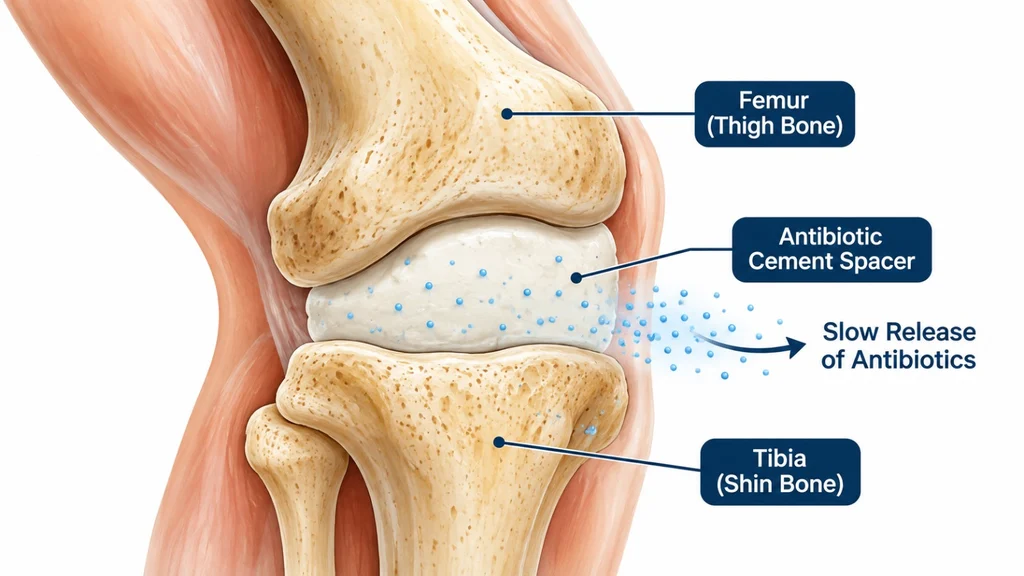
This is the part that confuses most patients. An antibiotic spacer is a temporary block made from bone cement mixed with a high dose of antibiotics. The surgeon places it in the joint after removing the infected implant.
It does two jobs:
- It releases antibiotics slowly, over about six weeks, straight into the infected area
- It keeps the joint space open, so the tissues don't shrink and the later reconstruction is easier
Keeping the space open also lets many patients move about with a walker rather than staying in bed. Spacers are made in different forms, such as hand-moulded, ready-made or custom-shaped in the operating theatre, and some knee spacers allow a little bending.
The Two-Stage Journey, Step by Step
For a long-standing infection, many surgeons prefer two stages. Here's how it usually unfolds.
| Stage | What happens | Roughly how long |
|---|---|---|
| Stage 1 | The infected implant is removed, the joint is cleaned and the spacer is placed, with antibiotics through a drip | One operation |
| Waiting period | Antibiotics continue while the infection clears and the spacer works | About six weeks in one study |
| Stage 2 | Once the infection is gone, the spacer is removed and a new implant is fitted | One operation |
In one well-known study, the whole process took about a year from start to finish. Your own timeline depends on your joint, your bacteria and how well your body responds.
Living With a Spacer
Between the two operations, the joint has limited use, and this period needs patience. After a knee or hip revision, you may walk with support and sometimes with limited weight on the leg. After a shoulder revision, a sling is often needed for longer than after a first replacement.
To get through it safely:
- Follow your weight-bearing instructions exactly
- Take every antibiotic dose as prescribed
- Report fever, new redness or wound discharge straight away
- Keep all your follow-up and blood test appointments
- Do the exercises your physiotherapist gives you
Blood clots in the leg or arm veins and lungs are possible, so keep moving as advised. PMG Hospital has an orthopaedic physiotherapy centre in Gota for rehabilitation after revision surgery.
How Well Does Treatment Work?
Reported success is encouraging. In the study mentioned above, antibiotic spacers cleared the infection in more than 90% of patients with knee and hip replacements, and a review of spacer use in hip and knee infections also reports control rates above 90% with two-stage exchange. The review adds that results differ between studies, so exact figures are hard to pin down.
It isn't risk-free. Sometimes infection returns or can't be cleared, which may mean further surgery, a permanent spacer or removal of the implant. Spacers can also dislocate or fracture, and the antibiotics in the cement can rarely cause problems for the kidneys, liver or blood. These are reasons to be treated by an experienced team.
Your own health also matters. If you have diabetes, smoke or live with other medical problems, tell the team early, because these can affect healing and the chance of clearing the infection. Steady blood sugar, good nutrition and staying active within your limits give the new implant a better start.
If you have a joint replacement and notice warmth, redness, discharge or fever, don't wait. Emergency care is available 24×7 at PMG Hospital, and for any other worry about your joint you can book a consultation. If you've been advised revision and want another view, a second opinion is a sensible step.
Frequently Asked Questions
What is an antibiotic spacer?
An antibiotic spacer is a temporary block of bone cement mixed with antibiotics. It's placed in the joint after an infected implant is removed, to release medicine slowly and keep the joint space open.
How long does an antibiotic spacer stay in?
Usually about six weeks, though your surgeon decides based on how the infection responds. A new implant is fitted in the second operation once the infection has cleared.
Can an infected joint replacement be saved without removing it?
Sometimes. An early infection, within a few weeks of surgery, may be treated by washing out the joint, changing removable parts and giving antibiotics while keeping the implant.
Can I walk with an antibiotic spacer?
Many people can, using a walker or other support, and sometimes with limited weight on the leg. Follow your surgeon's exact instructions.
Does an infected joint replacement always cause fever?
No. A low-grade infection may cause only increasing pain and stiffness, and blood tests can still look normal, so persistent pain should always be checked.
Conclusion
An infected joint replacement is serious, but it's treatable. Early infections can sometimes be cleared with a wash-out while the implant stays. Long-standing ones often need the implant removed, with an antibiotic spacer holding the space and delivering medicine while the infection clears, before a new implant is fitted.
The process takes time and patience, but most patients get through it with the right team. If you're worried about your joint replacement or have been told you may need revision, the team at PMG Hospital can examine you, explain each step in plain words and plan your treatment with you.