
You've had sugar for a few years, and you manage it with tablets or insulin. Then one day your shoulder starts aching at night. A few weeks later you can't comb your hair, fasten a seatbelt or reach for a shelf without wincing.
If this sounds familiar, you may be dealing with a frozen shoulder. And if you have diabetes, you're far from alone, because the two conditions often travel together.
This article explains why diabetes raises the risk, how it changes the course of the condition, and what you can do about it.
What Is a Frozen Shoulder?
The shoulder joint is surrounded by a thin, flexible capsule. In a frozen shoulder, this capsule becomes inflamed, then thick and tight, so the joint stops moving freely. It usually affects adults in their forties and fifties, and women more than men. It often begins without any clear injury.
The pain is typically worse at night, and the stiffness grows slowly. You can read about the full range of care on our page for frozen shoulder treatment in Ahmedabad.
Why Does Diabetes Raise the Risk?
Here's the honest answer: doctors don't fully understand why. What we do know is that the link is strong.
A 2026 systematic review and meta-analysis by Hernigou and Scarlat, published in International Orthopaedics, pooled data from more than 350,000 participants. It found that people with diabetes had about 3.7 times higher odds of developing frozen shoulders. Most of the included studies were observational, so they show a link rather than proof of cause.
One theory is that long-standing high blood sugar may change the connective tissue in the body, including the shoulder capsule, making it stiffer. Frozen shoulder is already most common between 40 and 60, an age when diabetes is also common, so many patients carry both risks at once. This hasn't been proven, but it fits with the finding that poorly controlled diabetes is listed as an added risk factor, and that screening is advised for people with long-standing or poorly controlled diabetes.
How Frozen Shoulder Differs When You Have Diabetes
Frozen shoulders behave differently in people with diabetes. Compared with others, it tends to be:
| Feature | People without diabetes | People with diabetes |
|---|---|---|
| Likelihood | Less common | Much more likely |
| Severity | Usually less severe | Often more severe |
| Duration | One to three years | Often longer |
| Shoulders affected | Usually one | More likely to affect both |
When both shoulders are affected, everyday tasks such as dressing, bathing, combing your hair and fastening a seatbelt become much harder, so it's worth seeking help early instead of waiting for the stiffness to pass.
For some people, a stiff shoulder is the first thing that leads to a diabetes diagnosis, which is why your doctor may check your blood sugar and thyroid when you come in with a painful, stiff shoulder.
The Three Phases, and What to Expect
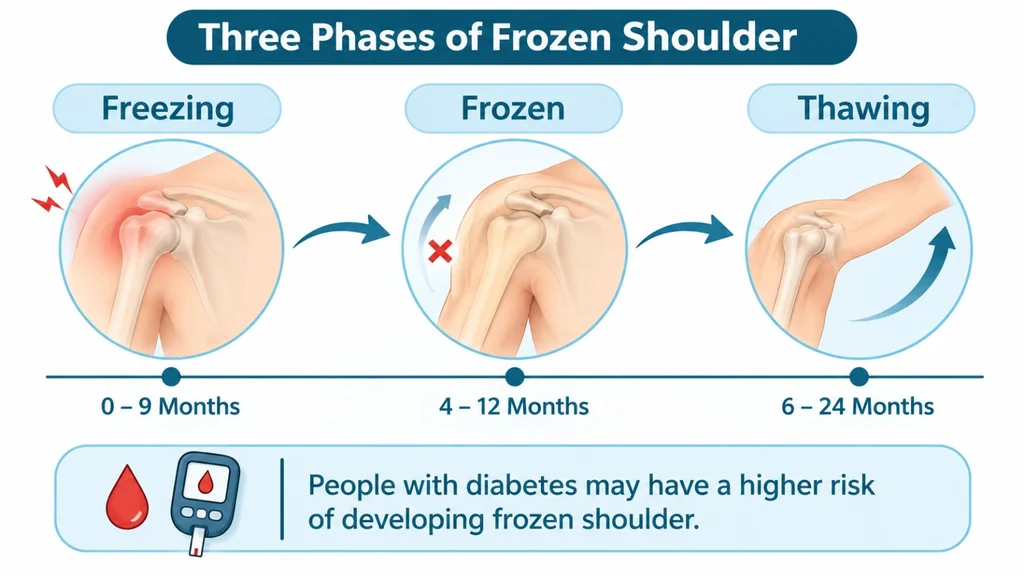
A frozen shoulder moves through three phases. The whole course often takes one to three years, and it may run longer when diabetes is involved.
| Phase | What you feel | How long it lasts |
|---|---|---|
| Freezing (painful) | Pain builds, often worse at night, and movement starts to drop | Several weeks to several months |
| Frozen (stiff) | Pain may ease, but stiffness is marked | Several months |
| Thawing (recovery) | Movement slowly returns | Several months to two years or more |
Night pain is often the hardest part. Many people find it easier to sleep on the unaffected side with a pillow supporting the painful arm, but if pain keeps waking you, tell your doctor, because pain relief and early treatment can help.
Could Your Stiff Shoulder Be a Warning Sign?
If you've never been told you have diabetes, it's worth asking. A stiff, painful shoulder that comes on slowly, with no injury, can occasionally be the first clue. Think about whether you've also noticed:
- Unusual thirst or passing urine more often
- Tiredness that doesn't improve with rest
- Cuts or sores that heal slowly
- A family history of diabetes
None of these proves diabetes, but a simple blood test gives a clear answer. The doctor may also test your thyroid, since thyroid problems are linked to frozen shoulders too. If the test shows high sugar, treating the diabetes won't undo the stiffness overnight, but good control makes injections and other shoulder treatment safer.
How Is It Diagnosed?
Diagnosis starts with your history and a careful examination, because a frozen shoulder limits both active and passive movement. An X-ray helps rule out arthritis, calcific tendinitis or a missed dislocation. Blood tests for sugar and thyroid are added when needed, and an ultrasound or MRI is reserved for selected cases, such as a suspected rotator cuff tear.
Treatment When You Have Diabetes
The treatments are largely the same, but the plan needs extra care with blood sugar.
| Treatment | When it is used | Point to remember with diabetes |
|---|---|---|
| Physiotherapy and pain relief | Almost everyone | Daily home exercises matter most |
| Steroid injection | Especially the early painful phase | Can raise blood sugar for a few days, so monitor it |
| Hydrodilatation | Marked stiffness in selected patients | Done under image guidance |
| Manipulation under anaesthesia | A shoulder very stiff after months of treatment | Needs careful assessment of bone strength |
| Arthroscopic capsular release | Very stiff, painful shoulder after months of treatment | Keyhole surgery to release the tight capsule |
A UK trial published in The Lancet in 2020, cited on our frozen shoulder page, found that the treatments it compared all helped most patients, although keyhole capsular release carried more serious complications and the highest cost. Most people improve with physiotherapy and time, and you can read about arthroscopy surgery in Ahmedabad if keyhole release is ever discussed. PMG Hospital also has an orthopaedic physiotherapy centre in Gota for the exercise part of treatment.
Sugar control and orthopaedic care are closely linked, as our article on managing blood sugar before and after knee replacement shows. If a rotator cuff tear is suspected instead, an ultrasound or MRI may be advised, and you can read about rotator cuff repair surgery in Ahmedabad.
How to Protect Your Shoulder If You Have Diabetes
You can't control everything, but a few habits help:
- Keep your blood sugar as steady as your doctor advises
- Don't rest a painful shoulder completely, because long periods without movement are a known risk factor
- Do gentle stretches as pain allows, and keep going daily
- Tell any doctor about your diabetes before an injection or procedure
- Check your sugar after a steroid injection, as it may rise for a few days
- Keep up your regular diabetes and thyroid check-ups, since they can pick up problems early
- See a doctor early if the shoulder is stiff for more than a few weeks
If your shoulder pain doesn't fit a frozen shoulder, our article on shoulder pain from arthritis or an old injury explains other common causes.
Don't wait too long to get help. If your shoulder has been stiff for several weeks and you have diabetes, you can book a consultation for a proper assessment.
Frequently Asked Questions
Why is frozen shoulder more common in people with diabetes?
The exact reason isn't fully understood. Research shows people with diabetes have much higher odds of frozen shoulder, and one theory is that long-standing high blood sugar stiffens connective tissue like the shoulder capsule.
How much more likely is frozen shoulder with diabetes?
A 2026 meta-analysis of more than 350,000 people found about 3.7 times higher odds of frozen shoulder in people with diabetes. The studies were mostly observational, so the link isn't proof of cause.
Does frozen shoulder last longer in diabetics?
Often, yes. In people with diabetes it tends to be more severe and last longer, and it is more likely to affect both shoulders.
Can a steroid injection raise blood sugar?
Yes, it can raise blood sugar for a few days. If you have diabetes, check your sugar regularly after the injection and tell your doctor beforehand.
Can frozen shoulders be the first sign of diabetes?
Sometimes. A painful, stiff shoulder with no clear injury can lead to a blood test that reveals diabetes, which is why doctors may check blood sugar when needed.
Conclusion
Frozen shoulder and diabetes are closely linked. People with diabetes have much higher odds of developing it, and it tends to be more severe, longer-lasting and more likely to affect both shoulders. Doctors don't fully know why, but the pattern is clear enough that a stiff, painful shoulder should always prompt a thought about blood sugar.
The encouraging news is that most people recover with exercise, patience and the right treatment at the right phase. If you or someone in your family has diabetes and a shoulder that won't move, the team at PMG Hospital can examine it, check for other causes and plan treatment around your sugar control.