
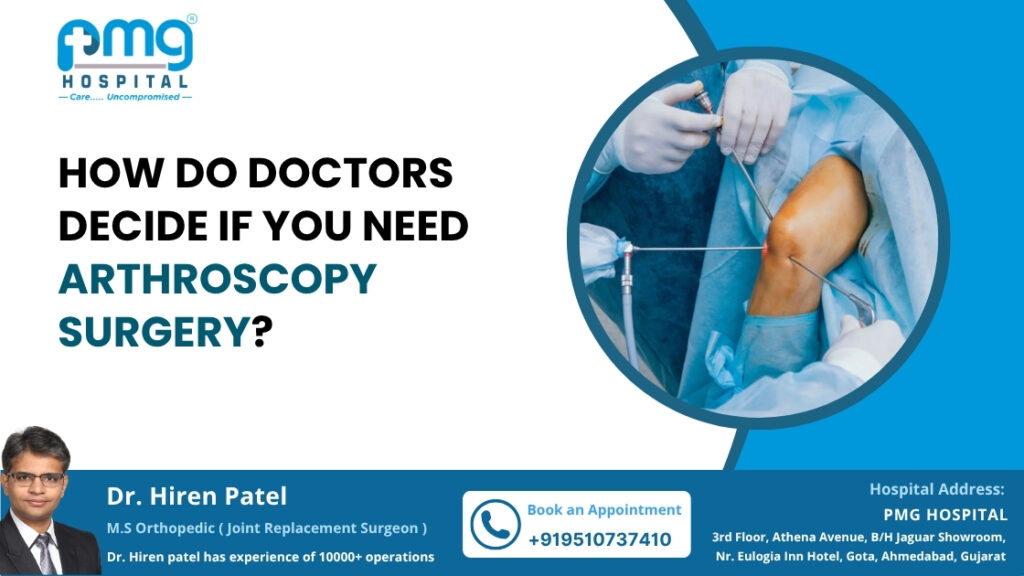
Joint pain doesn’t necessarily mean surgery is necessary. Lots of conditions can get better with rest, medication, physiotherapy, activity modification or other non-surgical treatments. However, if the pain lasts or you have a joint injury that continues to cause pain, your orthopedic doctor may want to consider an arthroscopy.
Well, in which circumstances is an arthroscopy surgery required?
It depends on a number of factors such as symptoms, physical exam, imaging, nature of the joint damage, and how the joint is responding to a previous treatment. The arthroscopy procedure may be utilized to examine a joint, and if necessary, to deal with joint problems with the help of tiny incisions. PMG Hospital states that arthroscopy can be employed for diagnosis and treatment for some joint conditions, including the knee, shoulder, hip, elbow, wrist and ankle.
What Is Arthroscopy Surgery?
Arthroscopy, sometimes called keyhole surgery, uses a small camera called an arthroscope to allow the surgeon to see inside a joint. Small surgical instruments can be introduced through additional small openings when treatment is required.
Depending on the condition, arthroscopy may be used to:
- Examine damaged cartilage
- Treat certain meniscus injuries
- Repair or reconstruct ligaments
- Remove loose fragments
- Address selected cartilage problems
- Treat some shoulder tendon or joint conditions
- Investigate persistent joint symptoms
The exact procedure depends on the joint involved and the underlying diagnosis.
When Is Arthroscopy Surgery Needed?
There is no single symptom that automatically means you need arthroscopy. Doctors generally consider surgery when the problem has been properly evaluated and less-invasive treatments have not provided adequate improvement, or when the injury itself requires surgical treatment.
Some important factors include:
- Persistent Joint Pain
Pain that continues despite appropriate conservative treatment may require further investigation.
For example, your doctor may initially recommend:
- Rest or activity modification
- Physiotherapy
- Medication when appropriate
- Strengthening exercises
- Lifestyle adjustments
If symptoms continue despite these measures, imaging and further orthopedic evaluation may help determine whether arthroscopy is appropriate.
This is particularly relevant when arthroscopy surgery for joint pain is being considered because the underlying cause needs to be identified before choosing an operation.
- A Confirmed Joint Injury
Certain injuries may be better treated surgically depending on their severity and the patient’s symptoms.
For example, an athlete with a significant knee ligament injury may require reconstruction rather than prolonged conservative treatment.
PMG Hospital’s ACL service explains that ACL injuries can cause symptoms such as knee pain, cracking sensations, instability, and difficulty putting weight on the affected leg.
- Your Knee Feels Unstable
A knee that repeatedly gives way, buckles, or feels unstable may indicate an underlying ligament or other structural problem.
Doctors may assess:
- Ligament stability
- Range of motion
- Muscle strength
- Previous injuries
- Knee alignment
- Imaging findings
If a structural problem is confirmed, arthroscopic treatment may be considered depending on the specific injury.
How Do Doctors Diagnose the Problem Before Surgery?
Before recommending arthroscopy, an orthopedic specialist generally needs to understand exactly what is causing the symptoms.
Medical History
Your doctor may ask:
- When did the pain begin?
- Was there an injury?
- Did you hear a pop or crack?
- Does the joint lock or catch?
- Does it swell after activity?
- Have you tried physiotherapy?
- Has the pain affected walking or daily activities?
These details help establish the pattern of the problem.
Physical Examination
The joint may be examined for:
- Tenderness
- Swelling
- Movement
- Stability
- Muscle strength
- Specific signs associated with ligament or cartilage injuries
Imaging Tests
Depending on the suspected condition, your doctor may recommend X-rays, MRI, or other investigations.
An X-ray can help assess bones and joint alignment, while MRI may provide more information about soft tissues such as ligaments, cartilage, and menisci.
The purpose is not simply to find an abnormality on a scan. The imaging findings need to match the patient’s symptoms and examination.
Can Arthroscopy Be Used for Knee Injuries?
Yes, knee arthroscopy is one of the commonly performed forms of arthroscopy.
Depending on the injury, arthroscopy treatment for knee injury may be considered for problems involving structures such as:
- Meniscus
- Certain ligaments
- Cartilage
- Loose bodies inside the joint
- Selected inflammatory or mechanical joint conditions
However, not every knee injury requires arthroscopy.
For example, some injuries respond well to physiotherapy and rehabilitation, while others may require reconstruction or another surgical procedure.
PMG Hospital‘s arthroscopy page lists knee arthroscopy alongside shoulder, hip, elbow, wrist, and ankle procedures.
What If Physiotherapy Has Not Worked?
Failure to improve with physiotherapy does not automatically mean surgery is required.
The next step is usually to reassess the diagnosis.
Your orthopedic specialist may ask:
- Was the original diagnosis correct?
- Has the injury changed?
- Is there another source of pain?
- Is there structural damage?
- Has the rehabilitation program been adequate?
- Would another treatment approach be more appropriate?
This approach is important because surgery should be recommended for a clearly identified problem rather than simply because pain has continued.
Arthroscopy vs Open Surgery
Arthroscopy is performed through relatively small openings using a camera and specialized instruments. In appropriate cases, this can allow the surgeon to access the joint without making the larger incision associated with some traditional open procedures.
However, arthroscopy is not automatically better than open surgery for every condition.
The appropriate technique depends on:
- Type of injury
- Location of damage
- Severity of the problem
- Joint involved
- Patient’s age and activity level
- Previous surgeries
- Overall joint condition
How Long Does Recovery Take?
Recovery varies significantly depending on what is done during the procedure.
A simple diagnostic or minor arthroscopic procedure may have a different recovery timeline from ligament reconstruction or cartilage treatment.
Factors affecting recovery include:
- Joint treated
- Type of procedure
- Extent of tissue damage
- Overall health
- Previous surgery
- Rehabilitation progress
- Physiotherapy compliance
PMG Hospital notes that recovery after arthroscopy can range from approximately one week to several months depending on the joint and procedure performed.
Therefore, patients should not compare their recovery timeline directly with another person’s experience.
Choosing an Arthroscopy Surgeon in Ahmedabad
If your doctor recommends arthroscopy, selecting an experienced orthopedic specialist is an important part of the process.
When looking for an arthroscopy surgeon Ahmedabad, consider whether the surgeon:
- Regularly performs arthroscopic procedures
- Treats your particular type of injury
- Explains both surgical and non-surgical options
- Reviews your imaging and examination findings
- Provides a clear rehabilitation plan
- Has appropriate orthopedic and physiotherapy support
PMG Hospital provides arthroscopy treatment as part of its orthopedic services and also offers ACL reconstruction, joint replacement, trauma care, and physiotherapy.
Questions to Ask Before Arthroscopy
Before deciding on surgery, it is reasonable to ask your orthopedic specialist:
About the diagnosis
- What exactly is causing my symptoms?
- Which structure is damaged?
- Do I need additional imaging?
About treatment
- Can my condition improve without surgery?
- Why are you recommending arthroscopy?
- What happens if I delay treatment?
- Is open surgery another option?
About recovery
- How long will I need to restrict activities?
- When can I walk normally?
- Will I need physiotherapy?
- When can I return to work or sports?
Having clear answers can help you make a more informed decision.
When Should You See an Orthopedic Specialist?
Consider an orthopedic evaluation if you have persistent or recurring:
- Joint pain
- Swelling
- Locking or catching
- Reduced movement
- Joint instability
- Pain after an injury
- Difficulty performing normal activities
Early assessment can help determine whether your condition requires continued conservative care, further investigation, or surgery.
If you are unsure about a recommended procedure, seeking a second opinion can also help you understand your treatment options before making a decision. PMG Hospital provides an orthopedic second-opinion service for patients seeking additional medical evaluation.
Conclusion
It is more important to understand when arthroscopy surgery is required, rather than to assume that any joint injury is an indication for surgery. Your doctor takes into account your symptoms, exam results, imaging, nature of your injury, joint function and if you’ve responded to non-surgical treatment before making a recommendation for arthroscopy.
Physiotherapy and other conservative measures might be enough for some patients. In these other individuals, when the structure is confirmed to be problematic, arthroscopy can be a reasonable choice.
Whether you have ongoing joint pain or have suffered a joint injury that is making it difficult to move, an orthopedic evaluation may help determine the cause and if arthroscopy surgery for joint pain is appropriate or another treatment is recommended.
Patients who are thinking of undergoing arthroscopy surgery Ahmedabad need to attain the understanding of the reasons for the surgery and what are the other options available.
